
Cricket Betting Odds Explained: Decimal, Fractional, and American Formats
 Available in US
Odds are the language of betting. They tell you how much you can win, how likely an outcome is considered, and whether a bet offers value. Yet many cricket bettors place wagers without fully understanding what the numbers on their screen actually mean. They know bigger numbers usually equal bigger potential payouts, but the relationship between odds and probability remains fuzzy. This knowledge gap costs money.
The global nature of cricket betting means you'll encounter three different odds formats depending on where you bet and which bookmaker you use. Indian and Australian bettors typically see decimal odds. British punters often encounter fractional odds, especially at traditional bookmakers. American sportsbooks display moneyline odds. Understanding all three formats gives you flexibility to bet anywhere and instantly recognize value regardless of how prices are displayed.
Decimal Odds: The Global Standard
Decimal odds have become the default format for most online bookmakers, and for good reason—they're the easiest to understand and calculate. The number you see represents your total return for every unit staked, including your original stake. If the odds are 2.50 and you bet 10 pounds, you receive 25 pounds back if you win. Simple multiplication tells you everything you need to know.
The calculation works identically regardless of the numbers involved. Odds of 1.50 on a 20-pound stake return 30 pounds (20 x 1.50). Odds of 8.00 on that same stake return 160 pounds (20 x 8.00). To find your profit rather than total return, subtract your stake from the result. That 160-pound return on 8.00 odds represents 140 pounds profit plus your original 20 pounds back. The mental math is straightforward once you internalize the formula: stake multiplied by odds equals total return.
Decimal odds also make probability calculation intuitive. Divide 1 by the odds to find the implied probability. Odds of 2.00 imply 50% probability (1 / 2.00 = 0.50). Odds of 4.00 imply 25% probability (1 / 4.00 = 0.25). Odds of 1.25 imply 80% probability (1 / 1.25 = 0.80). This conversion reveals what the bookmaker believes about each outcome's likelihood. When your own assessment differs from the implied probability, you've potentially identified a value bet worth further investigation.
The range of decimal odds tells you about the competitive balance the bookmaker perceives. When both teams in a cricket match are priced around 1.90-1.95, the bookmaker sees an essentially even contest. When one team is 1.20 and the other is 5.00, there's a heavy favorite. Decimal odds below 2.00 indicate the selection is considered more likely than not to succeed. Odds above 2.00 indicate the selection is considered less likely than not. This threshold provides an instant read on how the market views each outcome.
Fractional Odds: The Traditional Format
Fractional odds dominate in the United Kingdom and Ireland, particularly in horse racing and traditional betting shops. They express the potential profit relative to your stake rather than total returns. If something is priced at 3/1 (pronounced "three to one"), you profit three units for every one unit staked. A 10-pound bet at 3/1 wins 30 pounds profit, and you get your 10-pound stake back on top, for 40 pounds total return.
The fraction represents profit over stake. The number on the left (numerator) is your potential profit. The number on the right (denominator) is what you need to stake to win that profit. At 5/2, you profit 5 units for every 2 units staked. Betting 20 pounds at 5/2 means dividing your stake by the denominator (20 / 2 = 10), then multiplying by the numerator (10 x 5 = 50 pounds profit). Add your stake back for 70 pounds total return. The calculation requires an extra step compared to decimals, but becomes second nature with practice.
Fractional odds reveal favorites and underdogs through the relationship between numerator and denominator. When the first number exceeds the second (like 4/1, 7/2, or 9/4), the selection is an underdog—you profit more than you stake if you win. When the second number exceeds the first (like 1/2, 4/9, or 2/5), the selection is a favorite—you must stake more than you profit. These "odds on" prices indicate high probability outcomes where the bookmaker expects the selection to win more often than not.
Converting fractional odds to implied probability requires a specific formula: divide the denominator by the sum of both numbers, then multiply by 100. For 3/1 odds: 1 / (3 + 1) x 100 = 25% implied probability. For 1/4 odds: 4 / (1 + 4) x 100 = 80% implied probability. The math is less intuitive than decimal conversions, which partly explains why decimal odds have gained popularity among younger bettors who learned their craft online.
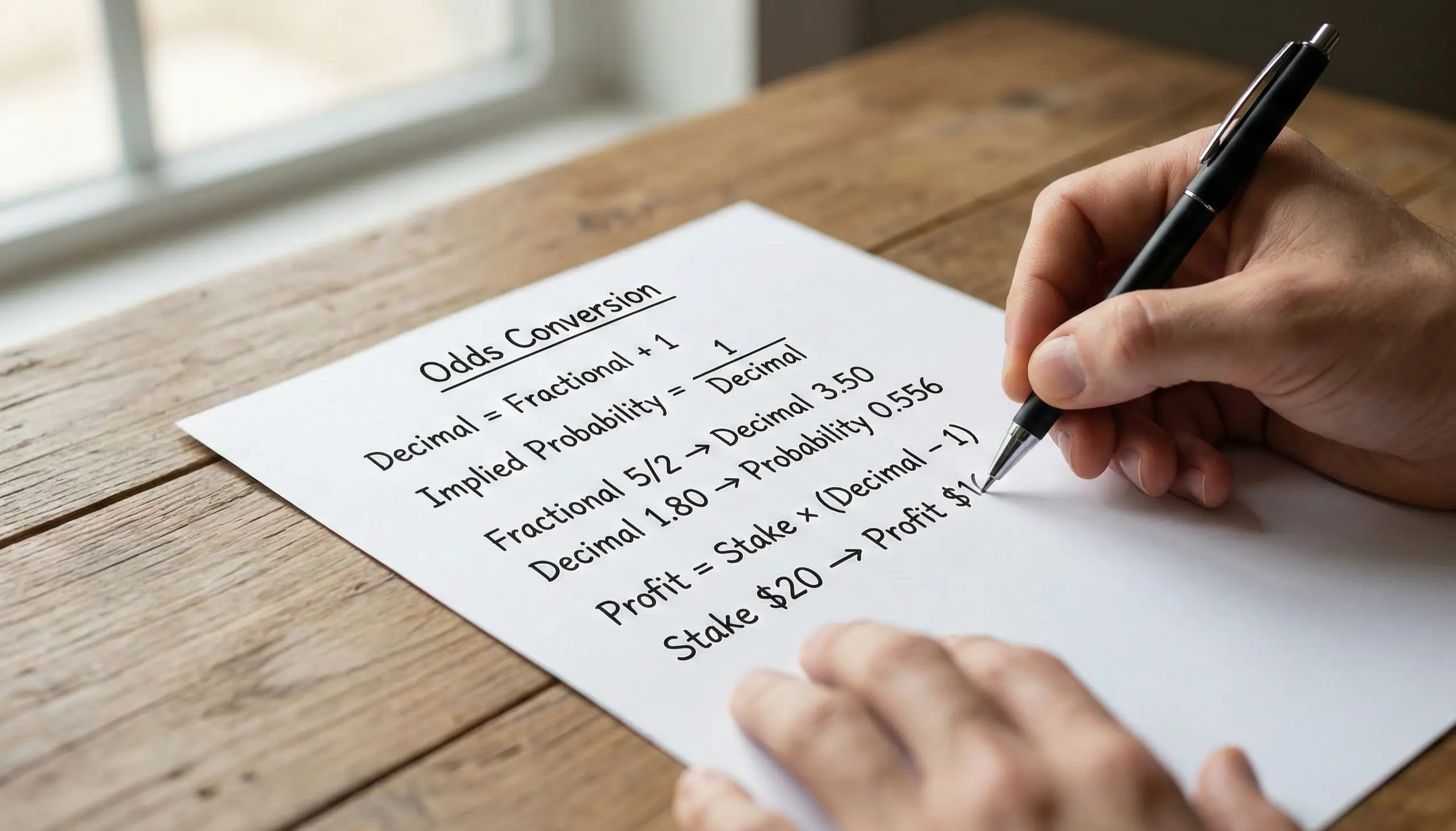
Understanding odds is the first step towards calculating returns.
American Odds: The Moneyline System
American odds, also called moneyline odds, use a baseline of 100 dollars to express prices. Positive numbers show how much you profit from a 100-dollar stake. Negative numbers show how much you must stake to profit 100 dollars. The system seems counterintuitive initially, but communicates the same information as other formats once you understand the logic.
Positive American odds indicate underdogs. If India is +250 against Australia, a 100-dollar bet on India returns 250 dollars profit plus your original stake if they win. The larger the positive number, the bigger the underdog and the larger your potential profit. +500 is a longer shot than +200. +150 is relatively close to even money. Calculating returns on stakes other than 100 dollars requires adjusting proportionally—a 50-dollar bet at +250 wins 125 dollars profit (half of what a 100-dollar bet would win).
Negative American odds indicate favorites. If Australia is -180 against India, you must stake 180 dollars to profit 100 dollars. The larger the negative number, the heavier the favorite and the more you must risk relative to potential profit. -300 is a stronger favorite than -150. -110 is close to even money. For returns calculation, determine what fraction of 180 dollars your stake represents, then multiply accordingly. A 90-dollar bet at -180 (half the baseline) wins 50 dollars profit (half of 100).
Converting American odds to probability differs based on whether they're positive or negative. For positive odds: 100 / (odds + 100) x 100. So +200 implies 100 / (200 + 100) x 100 = 33.3% probability. For negative odds: |odds| / (|odds| + 100) x 100. So -200 implies 200 / (200 + 100) x 100 = 66.7% probability. The absolute value notation simply means ignore the minus sign during calculation. These conversions aren't something you'll do mentally, but understanding the concept helps when analyzing American markets.
Converting Between Formats
Different bookmakers use different formats, and the best odds for any given match might appear on a site using an unfamiliar display. Being able to convert between formats, or at least recognize equivalent prices, expands your betting options significantly.
Decimal to fractional: Subtract 1 from the decimal odds, then express the result as a fraction. Decimal 3.00 becomes 3.00 - 1 = 2, or 2/1. Decimal 2.50 becomes 2.50 - 1 = 1.5, which converts to 3/2 (multiply both parts by 2 to eliminate the decimal). Decimal 1.80 becomes 0.80, which is 4/5. The conversion sometimes produces awkward fractions—this is why decimal odds have become preferred online, where precision matters more than traditional presentation.
Fractional to decimal: Divide the numerator by the denominator, then add 1. Fractional 5/1 becomes (5/1) + 1 = 6.00 decimal. Fractional 7/4 becomes (7/4) + 1 = 1.75 + 1 = 2.75 decimal. Fractional 1/3 becomes (1/3) + 1 = 0.33 + 1 = 1.33 decimal. This conversion always produces clean results, making fractional-to-decimal easier than the reverse.
American to decimal: For positive odds, divide by 100 and add 1. So +150 becomes (150/100) + 1 = 2.50 decimal. For negative odds, divide 100 by the absolute value of the odds, then add 1. So -150 becomes (100/150) + 1 = 0.67 + 1 = 1.67 decimal. Most online odds converters handle these calculations instantly, but understanding the logic helps when you encounter unfamiliar formats away from your computer.
What Odds Actually Tell You
Beyond calculation mechanics, odds communicate information about market expectations and bookmaker confidence. Learning to read this information elevates your betting from mechanical to analytical.
Odds reflect both probability assessment and bookmaker margin. If a cricket match were truly 50/50, fair odds would be 2.00 on each side. But bookmakers need profit, so they might price both sides at 1.90. The gap between fair odds and offered odds represents the bookmaker's edge. Tighter margins (odds closer to fair value) indicate more competitive markets where bookmakers are confident in their pricing. Wider margins often appear in exotic markets or obscure leagues where bookmakers pad their edge against uncertainty.
Line movement reveals market sentiment and information flow. If India opens at 1.80 and moves to 1.65 before the match, money is flowing toward India—possibly from sharp bettors with superior information. If the odds drift from 1.80 to 2.00, the opposite is happening. Tracking these movements helps identify where smart money is going, though you must distinguish between genuine information and recreational money creating false signals.
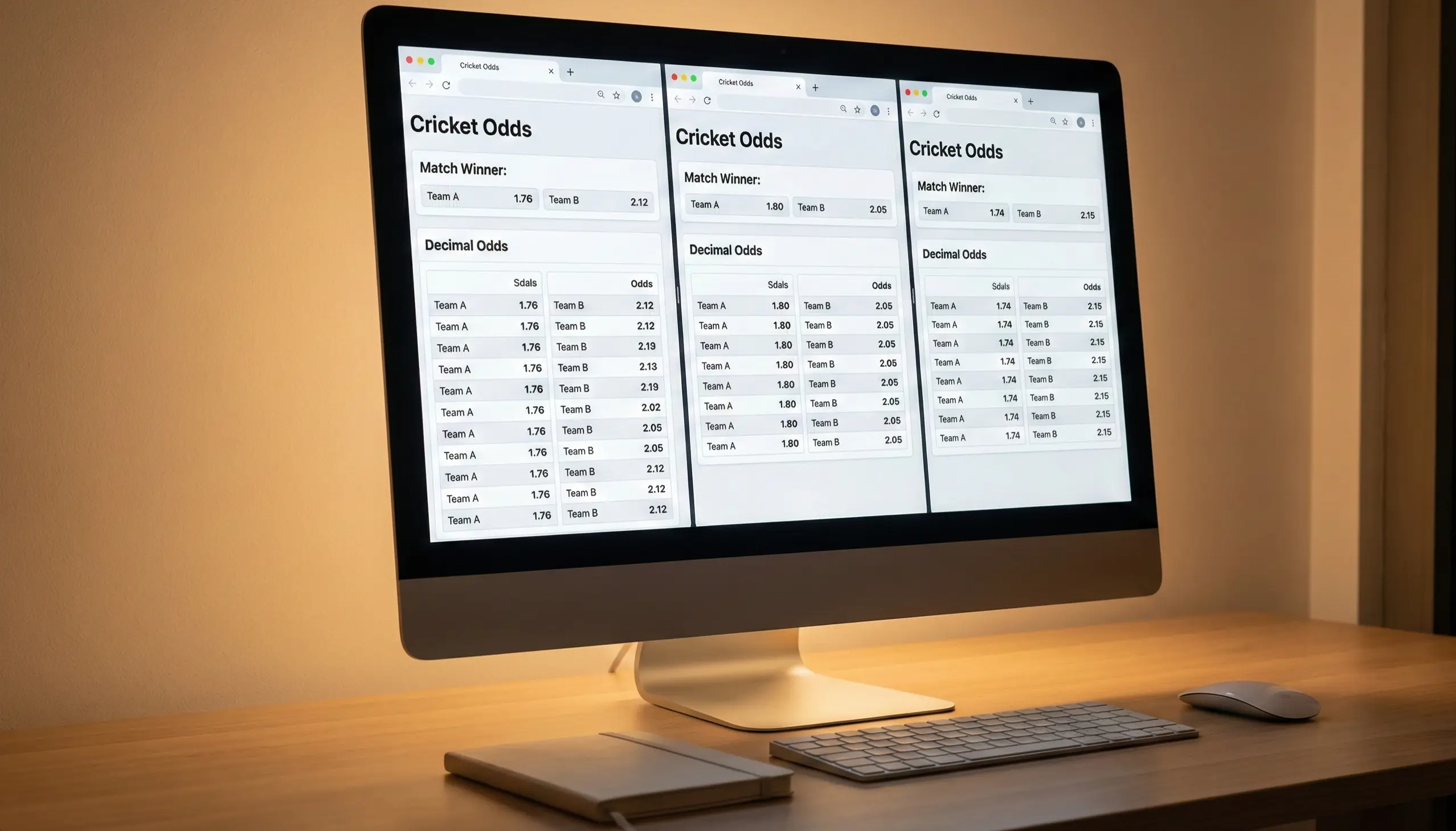
Comparing odds across bookmakers identifies pricing inefficiencies. One site might have India at 1.95 while another has 1.85. The 1.95 price offers better value if you believe India will win. Over time, consistently getting the best available odds makes significant difference to profitability. This is why serious bettors maintain accounts at multiple bookmakers and compare prices before every bet rather than accepting whatever their primary bookmaker offers.
Choosing Your Preferred Format
Most bookmakers allow you to select your preferred odds display in account settings. This personal choice doesn't affect actual payouts—just how information is presented. But choosing the format you understand intuitively improves decision-making speed and reduces calculation errors.
Decimal odds suit most bettors learning the craft today. The calculations are simpler, the probability conversions are intuitive, and most major betting exchanges use decimal format. Unless you grew up with fractional odds and find them natural, decimal is the logical choice for clarity and speed.
Whichever format you prefer, ensure you can at least recognize the others. You'll encounter fractional odds in UK-focused content and American odds when reading US betting analysis. Being fluent in all three formats means you never miss value because prices were displayed unfamiliarly. The few minutes spent understanding each system pays dividends throughout your betting career.
The goal isn't mastering odds theory but developing practical fluency that supports profitable betting. When you see odds on screen, you should instantly know what they mean, how much you could win, and what probability they imply. That fluency removes one barrier between you and informed wagering decisions.
Return to the CricketBetTips hub.
