
How to Calculate Cricket Betting Returns and Potential Profits
 Available in US
Knowing how much you stand to win before placing a bet seems obvious, yet many bettors click "confirm" without fully understanding their potential returns. They see odds, have a vague sense that bigger numbers mean bigger wins, and hope for the best. This approach guarantees confusion and prevents informed bankroll management. If you don't know exactly what you're risking for what potential reward, you're not really betting—you're guessing.
Calculating returns requires nothing more than basic arithmetic, but the formulas differ depending on odds format and bet type. Mastering these calculations transforms betting from a game of hunches into a calculated activity where you understand precisely what's at stake with every wager.
Single Bet Calculations
Single bets involve one selection with one potential outcome. You back India to beat Australia, and either India wins (you profit) or they don't (you lose your stake). The calculation depends on which odds format you're using.
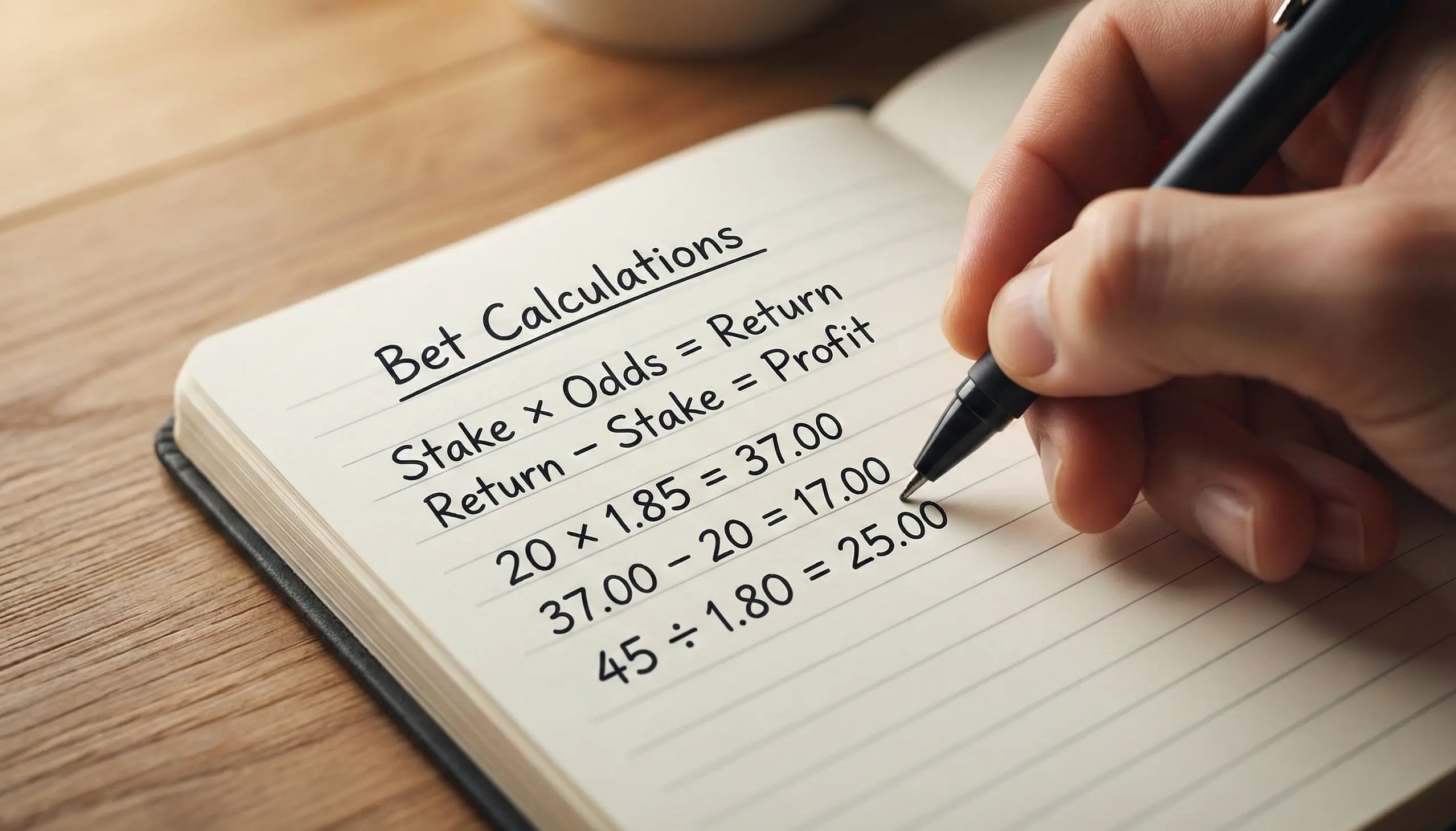
Decimal odds make calculation straightforward. Multiply your stake by the odds to find total return. If you bet 25 pounds at odds of 2.40, your total return is 60 pounds (25 x 2.40). This includes your original stake, so your profit is 35 pounds (60 - 25). The formula never changes regardless of the numbers involved. Stake of 100 at odds of 1.65 returns 165 total, profit of 65. Stake of 50 at odds of 5.00 returns 250 total, profit of 200. Every decimal odds calculation works identically.
Fractional odds require an additional step. First, divide the numerator by the denominator to find your profit multiplier. Then multiply by your stake to find profit. Finally, add your stake back for total return. Betting 20 pounds at 7/2: divide 7 by 2 to get 3.5, multiply by 20 to get 70 pounds profit, add your 20 stake for 90 pounds total return. At 4/9 (odds on): divide 4 by 9 to get approximately 0.44, multiply by 45 pounds stake to get 20 pounds profit, add stake for 65 pounds total return.
American odds calculations split between positive and negative numbers. For positive odds like +150, divide the odds by 100 and multiply by your stake to find profit. A 40-pound bet at +150: divide 150 by 100 to get 1.5, multiply by 40 for 60 pounds profit, add stake for 100 pounds total return. For negative odds like -200, divide 100 by the absolute value of the odds, then multiply by stake. A 40-pound bet at -200: divide 100 by 200 to get 0.5, multiply by 40 for 20 pounds profit, total return 60 pounds.
The goal of calculation is to identify value betting in cricket.
Multiple Bet Calculations
Accumulators, also called parlays or multis, combine multiple selections into one bet. All selections must win for the bet to pay out—one loser means the entire accumulator loses. The attraction is multiplied odds creating potentially massive returns from small stakes. The risk is that losing probability compounds just as dramatically.
Calculating accumulator returns involves multiplying individual odds together. If you back three teams at 1.80, 2.10, and 1.95 in decimal odds, multiply all three: 1.80 x 2.10 x 1.95 = 7.371. A 10-pound stake at combined odds of 7.371 returns 73.71 pounds. Each additional selection multiplies potential returns but also multiplies the probability of losing. Four selections at reasonable odds might offer 15x returns, but your chances of winning all four might be only 5-10%.
The mathematics of accumulators reveal why they're beloved by recreational bettors and bookmakers alike. Small stakes can produce life-changing wins—the dream scenario that keeps people betting. But expected value is typically worse than singles because you're compounding individual market margins. If each single bet has slight negative expected value due to bookmaker edge, combining them multiplies that disadvantage. Accumulators can be fun entertainment bets, but professional bettors rarely use them except in arbitrage situations.
Calculating fractional accumulator odds requires converting to decimal first, multiplying, then converting back if desired. This complexity is why most bettors switch to decimal odds when placing multiples. American odds follow similar logic—convert to decimal, multiply combined odds, convert the result if you need American format for some reason.
Understanding Implied Probability
Every odds price implies a probability that the bookmaker assigns to that outcome. Converting odds to implied probability reveals whether you're getting fair value for your assessment of likely outcomes. If you believe India has a 60% chance of winning but odds imply only 45% probability, the bet has positive expected value regardless of whether India actually wins.
Decimal to probability conversion divides 1 by the odds. Odds of 2.00 imply 50% probability (1/2.00 = 0.50). Odds of 4.00 imply 25% probability. Odds of 1.25 imply 80% probability. This calculation instantly shows what chance the bookmaker gives each outcome. When you disagree with this assessment based on your own analysis, you've identified potential value.
Fractional odds convert through a different formula: denominator divided by (numerator plus denominator). For 3/1 odds: 1 divided by (3+1) equals 0.25 or 25% implied probability. For 1/4 odds: 4 divided by (1+4) equals 0.80 or 80% implied probability. The calculation is less intuitive than decimal conversion but produces identical results for equivalent odds.
The bookmaker's margin becomes visible when you add implied probabilities for all outcomes. In a two-outcome market, fair odds would sum to 100%. If India is 1.90 (52.6%) and Australia is 1.90 (52.6%), the total is 105.2%. That extra 5.2% represents the bookmaker's margin—their expected profit regardless of outcome. Tighter margins indicate more competitive odds; wider margins indicate more bookmaker edge. Shopping across bookmakers to find tighter margins directly improves your expected returns.
Calculating Expected Value
Expected value (EV) quantifies whether a bet is mathematically sound over the long run. Positive EV bets profit over time even if individual bets lose. Negative EV bets lose money over time even if individual bets sometimes win. Calculating EV requires estimating true probability and comparing it to odds offered.
The EV formula multiplies probability of winning by potential profit, then subtracts probability of losing multiplied by stake. If you assess India at 55% to win at odds of 2.10 with a 10-pound stake: (0.55 x 11 profit) - (0.45 x 10 stake) = 6.05 - 4.50 = +1.55 EV. This positive EV suggests the bet is mathematically sound. If your probability assessment were 45% instead: (0.45 x 11) - (0.55 x 10) = 4.95 - 5.50 = -0.55 EV. Negative EV suggests the bet loses money long-term.
EV calculation assumes your probability assessments are accurate—a significant assumption. If you consistently overestimate your selections' chances, your "positive EV" bets are actually negative EV based on true probabilities. Tracking bet outcomes over hundreds of wagers reveals whether your assessments prove accurate. Until you have this data, treat EV calculations as estimates rather than certainties.
Professional bettors obsess over EV because they understand that short-term results mean little. A +EV bet can easily lose. A -EV bet can easily win. But over thousands of bets, mathematics asserts itself. Consistent +EV betting produces profit; consistent -EV betting produces losses. The challenge is genuinely identifying +EV opportunities rather than fooling yourself into seeing value that doesn't exist.
Practical Calculation Examples
Let's work through several realistic scenarios to cement understanding.
Scenario one: Simple decimal bet. You back England at 1.75 with 30 pounds. Total return if England wins: 30 x 1.75 = 52.50 pounds. Profit: 52.50 - 30 = 22.50 pounds. Implied probability: 1/1.75 = 57.1%. If you assess England's true chances at 62%, you've found positive expected value.
Scenario two: Fractional odds calculation. You back Australia at 5/2 with 40 pounds. Profit calculation: (5/2) x 40 = 100 pounds profit. Total return: 100 + 40 = 140 pounds. Converting 5/2 to decimal: (5/2) + 1 = 3.50. Verification: 40 x 3.50 = 140 pounds total return. Same answer, confirming the calculation.
Scenario three: Three-team accumulator. You back India (1.80), Pakistan (2.20), and Sri Lanka (1.65) with 15 pounds. Combined odds: 1.80 x 2.20 x 1.65 = 6.534. Total return if all win: 15 x 6.534 = 98.01 pounds. Profit: 98.01 - 15 = 83.01 pounds. The potential return is attractive, but you need all three teams to win—one loser means losing your entire 15 pounds.
Scenario four: Comparing bookmaker odds. Bookmaker A offers South Africa at 2.30. Bookmaker B offers 2.45. On a 50-pound bet, Bookmaker A returns 115 pounds while Bookmaker B returns 122.50 pounds—a 7.50-pound difference for identical outcome. Over hundreds of bets, taking the best available odds creates significant profit difference.

Using Calculation in Betting Strategy
These calculations aren't academic exercises—they inform every betting decision. Before placing any bet, you should know exactly what you stand to win or lose. This knowledge enables proper stake sizing based on your bankroll management rules. If your maximum bet is 5% of bankroll and your bankroll is 500 pounds, you know your stake can't exceed 25 pounds regardless of how confident you feel.
Comparing potential returns across different markets helps identify best opportunities. If top batsman Kohli offers +180 returns compared to match winner India offering +40 returns on equivalent probability assessments, the top batsman market presents better value. Of course, probabilities differ between markets, but calculation enables comparison.
Tracking return on investment requires accurate record keeping of stakes, odds, and outcomes. Your betting spreadsheet should calculate ROI automatically—total profit divided by total stakes wagered. A 500-pound profit on 5,000 pounds wagered represents 10% ROI, regardless of whether you're betting 10 pounds or 100 pounds per wager. This metric measures your edge over time and reveals whether your betting approach actually works.
The mental discipline of calculation protects against impulsive betting. When you pause to calculate returns, you naturally consider whether the bet makes sense. That brief moment of reflection prevents many bad bets that emotion or excitement would otherwise produce. Treat calculation not just as mathematics but as a decision-making checkpoint before every wager.
Use our tools on the CricketBetTips homepage.
