
Cricket Betting Markets Explained: Every Bet Type You Can Make
 Available in US
Here's what nobody tells you about cricket betting markets: the match winner bet is probably the worst place to put your money. I know that sounds backwards. Match winner is where everyone starts, where bookmakers feature it prominently, where it feels safest. But it's also the most efficiently priced market because everyone bets on it, meaning the bookmaker margin is baked in and value is nearly impossible to find.
The real money in cricket betting comes from understanding the dozens of other markets bookmakers offer. Player props, totals, sessions, innings bets, live markets—these are where bookmakers make mistakes, where your research creates actual edges, where profitable bettors make their money.
Most guides list every available market with brief descriptions. That's useless. You don't need a catalog, you need to understand which markets offer value, which ones are traps designed to drain recreational bettors, and how to approach each one strategically. That's what this guide provides.
We'll break down every major cricket betting market from a practical perspective. Not what the markets are—you can figure that out from the bookmaker interface—but when they offer value, what factors move the odds, and how to bet them profitably. Some markets you should avoid entirely. Others you should bet every match if conditions are right. Knowing the difference is the entire game.
Match Winner Markets: The Obvious Starting Point

The match winner market asks you to pick which team wins the match. In Test cricket, there's a third option for draws. In limited-overs formats, one team must win unless weather causes abandonment. It's conceptually simple, which is precisely why finding value is difficult.
Bookmakers price match winner markets efficiently because betting volume is enormous. Every casual bettor puts money on match winners. Every professional bettor analyzes match winners. This collective action forces odds toward true probability faster than any other market. The bookmaker margin—typically 3-5% on major international matches—gets split across both teams, leaving minimal room for profit.
That doesn't mean you should never bet match winners. It means you need genuine edges to overcome the efficient pricing. Injury news that breaks after odds are set but before the bookmaker adjusts creates temporary value. Conditions that favor one team's playing style more than the market recognizes creates edges. Weather forecasts changing dramatically between when odds open and when the match starts creates opportunity.
The key is being faster with information or more accurate with analysis than the collective market. If a star player is ruled out and you bet immediately before casual bettors and bookmakers react, you have edge. If you've studied a venue's pitch characteristics and recognize conditions favor one team more than odds suggest, you have edge. Without these specific advantages, match winner bets are coin flips with a built-in house edge.
Test match draws deserve special attention. Roughly one in four Test matches ends drawn. Flat pitches that produce high scores make draws likely because teams can't dismiss opponents twice in five days. Rain forecasts make draws much more probable. But recreational bettors underbet draws because they're boring—nobody watches hoping for a stalemate.
This creates value. When pitch reports indicate a flat track and weather forecasts show rain for two of five days, the draw might be 35-40% probable but priced at 25% implied probability. That gap is exploitable. The challenge is accepting that draw bets often take five days to resolve and feel like "wasted" opportunities while the match unfolds. Emotionally, backing a team to win is more satisfying. Financially, backing draws when probability supports it is more profitable.
Draw no bet markets remove the draw option, refunding your stake if neither team wins. This sounds appealing—eliminate one losing outcome for free! But nothing is free. The bookmaker worsens your odds to compensate for removing draw risk. Whether draw no bet offers value depends on your estimated draw probability compared to how much the odds worsened. Usually, it doesn't. You're better off handicapping the draw probability accurately and betting accordingly rather than paying the bookmaker to eliminate it for you.
Player Performance Markets: Where Value Lives

Top batsman and top bowler markets ask you to predict which player will score the most runs or take the most wickets for their team in the match. These markets are less efficiently priced than match winners because bookmakers can't devote equal analytical resources to every market, and fewer sharp bettors analyze them carefully.
Batting order creates massive distortions in top batsman odds. Openers face more balls than middle-order batsmen, giving them statistical advantage to top-score. This advantage gets priced in—openers have shorter odds. But context matters enormously. If the pitch is seaming and quality pace bowlers are attacking, openers face the hardest batting conditions. A number four or five batsman might face fewer balls but much easier conditions after the pitch flattens, making them more likely to top-score despite longer odds.
Form matters more in player markets than team markets. A batsman who's scored three consecutive fifties has genuine momentum—confidence, timing, mental clarity. That recent form should make them more likely to score big than their career statistics suggest. Conversely, a batsman in horrible form struggling for runs won't magically rediscover their best in one match. The bookmakers adjust odds for form, but often not enough. Recent performance creates edges when you weight it more heavily than career averages.
Match-ups between batsmen and bowlers rarely get fully priced into player props. If a left-arm spinner has historically dominated a certain right-handed batsman, that batsman's top scorer odds should be longer than normal. If a pace bowler consistently troubles a batting lineup's opening pair, those openers are overvalued. Deep statistical analysis of player-versus-player records reveals patterns that algorithms miss.
Top bowler markets require understanding bowling roles. Not all bowlers have equal opportunity to take wickets. Opening bowlers get the new ball and fresh batsmen—advantages. But they might bowl again later when batsmen are set. First-change bowlers often clean up after openers create pressure. Death-over specialists face batsmen attacking recklessly, producing wickets from poor shots rather than good balls. Which role has the highest wicket probability changes based on conditions.
Player milestone markets offer high-odds opportunities that require strong conviction. Will a batsman score a fifty? A century? Will a bowler take three wickets? Five wickets? These bets require combining form analysis, conditions assessment, and opposition quality into a single prediction. A batsman averaging 60 in the format might have 20% probability to score a century in ideal conditions against weak bowling, or 3% probability in tough conditions against quality bowling. The odds need to reflect those shifting probabilities, but they adjust slowly.
The trick with milestone bets is they work best as small-stake, high-odds plays. You can't bet them every match profitably. But when conditions align—a batsman in extraordinary form, facing weak bowling, on a flat pitch—milestone bets at 5.00 or 8.00 odds can have positive expected value. Three or four such bets per season that win pay for ten that lose.
Man of the match markets encompass entire performance across batting, bowling, and fielding. All-rounders have inherent advantage since they contribute in multiple disciplines. Winning team members are favored in voting, though exceptional performances in losses sometimes win. These markets are difficult to predict pre-match but become much clearer during play.
Live betting man of the match during matches when one player is dominating offers value. If a batsman reaches 80 not out with their team headed toward victory, they're probably man of the match. But bookmakers might offer 2.50 odds because technically the match isn't finished and someone could take a five-wicket haul in the second innings. Betting man of the match on obvious candidates during matches beats pre-match punts that are essentially lottery tickets.
Totals and Runs Markets: Conditions-Based Betting

Total runs markets ask you to bet over or under a bookmaker-set line for team or match runs. These markets require synthesizing multiple variables—pitch conditions, weather, team batting quality, opposition bowling quality—into a single prediction about scoring levels.
Pitch analysis is foundational to totals betting. Fast, bouncy pitches with grass coverage help seamers and make batting difficult. Expect totals below average. Flat, hard pitches with minimal grass are batting paradises. Expect totals above average. Worn pitches that have hosted multiple matches crack and turn, helping spinners and lowering totals. Learning to assess pitch characteristics from photos and curator comments is a skill developed through experience, but it transforms totals betting from guessing to informed analysis.
Weather affects totals in ways that are predictable if you check forecasts. Overcast conditions help swing bowling, making batting harder and lowering expected totals. Sunny weather favors batsmen. In subcontinental evening matches, dew makes the ball slippery for bowlers, helping batting sides score more freely. All these factors are objectively measurable—you just need to check weather reports and understand the implications.
Ground dimensions directly correlate with scoring rates but get overlooked constantly. Small grounds with short boundaries see more sixes and fours, pushing totals higher. Large grounds require more running between wickets and placement, producing fewer runs. This information is publicly available for every cricket ground, yet recreational bettors ignore it. If you're betting totals in T20 cricket especially, checking boundary dimensions is mandatory. A 160 total at a large ground might be equivalent to 180 at a small ground in terms of competitiveness.
Batting depth affects how teams maximize resources. A team with batting down to number eight or nine can post big totals even after early wickets because lower-order players contribute. Teams with weak tails collapse quickly once top-order batsmen fail, limiting total runs. This shows up in statistics over time—some teams consistently outperform expected totals because their depth allows late-innings runs, while others consistently fall short because their tail contributes nothing.
Powerplay totals in limited-overs cricket offer sharp betting opportunities. The first 10 overs in ODIs and first six overs in T20s have fielding restrictions that affect scoring. Bookmakers set over/under lines for powerplay runs, but these lines often don't adjust properly for specific matchups. If a team has aggressive openers facing a weak new-ball attack on a flat pitch, powerplay overs might be underpriced. If the opposite—a conservative opening pair facing quality seamers in seaming conditions—powerplay unders offer value.
First innings totals isolate one team's performance from match result variables. If you believe India will score 320 in an ODI but aren't sure if England can chase it successfully, bet India first innings over 300.5 rather than betting match winner. You're removing the uncertainty about what happens after India bats. This is particularly useful when one team's performance is predictable but the opponent's response isn't.
Session runs in Test cricket break matches into digestible chunks. Morning, afternoon, and evening sessions each have over/under markets on runs scored. These markets let you bet on conditions as they evolve. If you expect a pitch to be most difficult for batting in the morning session when the ball is new and conditions are fresh, you bet session runs under. If you think the afternoon will see easier batting as the pitch flattens, you bet session runs over. This granular approach to Test betting beats trying to predict five-day outcomes.
Boundary markets—total fours, total sixes, player boundaries—are niche but can be profitable in T20 cricket. Boundary counts correlate with ground dimensions, pitch pace, and batting aggression. Small grounds with fast pitches produce more sixes. Slow pitches produce more fours as batsmen can't clear the boundary easily. If you understand these relationships, you spot when boundary markets are mispriced relative to conditions.
Live Betting Markets: Real-Time Opportunity
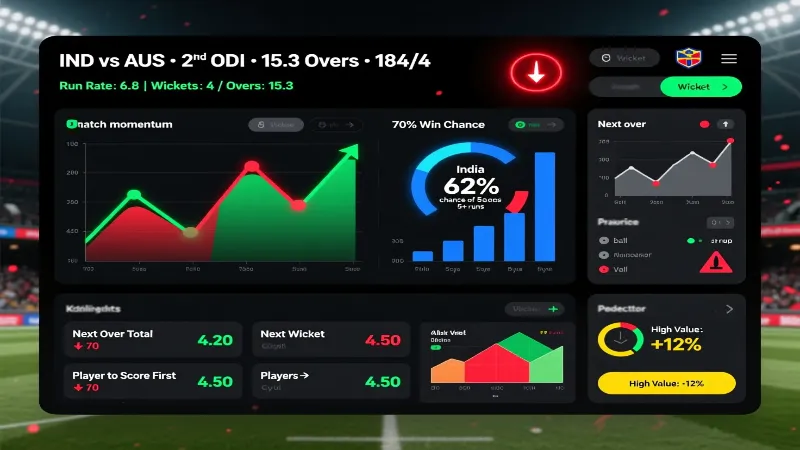
In-play betting transforms cricket from pre-match predictions into dynamic real-time decision making. As matches unfold, bookmakers continuously update odds based on current state—score, wickets, overs remaining, required run rate, momentum. This creates opportunities to bet when you believe odds haven't adjusted properly or when you can read the match better than algorithms.
Next over runs is the shortest timeframe market available. Bookmakers set over/under lines for runs scored in the next over, typically around 5.5 or 6.5 runs depending on format and situation. This is essentially gambling if done randomly, but with context, edges appear. A settled batsman facing a weak bowler makes over more likely. A new batsman against quality bowling makes under likely. You're using information about current match state that wasn't available pre-match.
Next wicket method markets predict how the next dismissal occurs—caught, bowled, LBW, run out, stumped. These markets require deep cricket knowledge. Caught is most common, roughly 50-55% of all dismissals. Bowled is maybe 20-25%. LBW is 15-20%. Run outs, stumpings, and other methods are rare. But conditions shift these probabilities. If a spinner is bowling with close catchers, caught odds might be too long. If batsmen are running aggressive twos, run-out odds might be undervalued.
Partnership runs markets predict how many runs the current batting partnership adds before the next wicket. These odds update constantly based on scoring rate and batsmen at crease. A new batsman just arriving gets lower partnership odds than a settled batsman who's faced 50 balls. But bookmakers sometimes overreact to wickets, creating value. If a wicket falls but two capable batsmen are now batting together, partnership odds might be too long simply because the algorithm saw "wicket" and lengthened odds without considering who's actually batting now.
Current innings runs totals update during innings based on runs scored so far. If India is 150/3 after 30 overs in an ODI, bookmakers might set their final total at 265.5. You bet over if you think they'll score faster than 5.75 per over for the remaining 20 overs, under if you think they'll score slower. These live totals reflect real-time information about batting form, bowling effectiveness, and momentum that wasn't available pre-match. Watching matches and betting these live totals beats pre-match total bets if you can assess situations accurately.
Match odds on the winner change continuously during play. A team might start 1.80 favorites, drift to 3.00 after losing early wickets, then crash back to 1.40 after posting a huge total. If you believe the market overreacts to short-term events, you back teams at inflated odds. The challenge is separating genuine momentum shifts from variance. Two quick wickets don't necessarily change a team's fundamental quality, but odds react as if they do. When you identify overreactions, value exists.
The key to profitable live betting is watching matches rather than just checking scores. Scoreboard doesn't tell the full story. A team might be 50/0 after 10 overs, but if both openers are playing and missing frequently and getting beaten regularly, they're lucky to still be there. Odds might show them as favorites because of the score, but their actual performance suggests wickets are coming. Conversely, a team might be 35/2 but the two dismissed batsmen got excellent deliveries and the current batsmen look comfortable. Odds lengthen based on wickets lost, but watching reveals the situation isn't as bad as the score suggests.
Cash-out functionality deserves mention as a live betting tool, though it's often misused. Cash-out lets you close bets before matches finish, locking in profit or cutting losses. If you backed India pre-match at 2.00 and they're now 1.40 favorites during the match, cash-out might offer you £160 return on a £100 bet—guaranteed profit without waiting for the match to finish. This sounds great, but the cash-out amount is always worse than betting the other side at current odds yourself. The bookmaker takes a margin for providing the convenience.
Use cash-out strategically, not emotionally. If you have information that odds don't reflect—you're watching and see a team collapsing under pressure while odds haven't adjusted yet—cash out makes sense. If you're just nervous and want to "lock in profit" without analytical reason, you're probably giving the bookmaker free money. Calculate whether you're better off cashing out or letting the bet run. Often, you're better off accepting the variance and taking full odds on winners.
Innings and Phase-Specific Markets
First innings winner in Test cricket asks which team will score more runs in their first innings. This bet resolves after both teams bat once, not after the entire match. It's useful when you have conviction about first innings performance but uncertainty about the full five-day result. Maybe you think India will dominate England's first innings but aren't confident about what happens over five full days. Betting first innings winner isolates the specific part you feel confident about.
Fall of next wicket markets predict the score when the next dismissal occurs. If a team is 50/2, bookmakers might set the line at 75.5 for when the third wicket falls. You're betting on whether the current partnership adds more or fewer than 25 runs. This requires assessing current batsmen quality, bowling quality, conditions, and momentum. It's essentially partnership betting but phrased differently. The same analytical approach applies—are these batsmen settled? Is the bowling looking threatening? What do conditions suggest about likely scoring rate?
Method of dismissal for specific batsmen is a pure punt unless you have detailed knowledge. Bookmakers offer odds on whether a particular batsman will be caught, bowled, LBW, etc. This is nearly impossible to predict with any accuracy. The only time it makes sense is if you've identified a specific vulnerability—a batsman who consistently gets bowled because of technical flaws against a particular bowling type. Even then, it's speculative. These markets exist to attract recreational bettors who think they're clever, not to provide value.
Highest opening partnership predicts which team's openers will add more runs before the first wicket falls. This is straightforward if you understand opening batsman quality and new-ball bowling quality for both teams. If one team has quality openers facing a weak new-ball attack while the other has mediocre openers facing excellent seamers, the first team should be heavily favored. But bookmakers sometimes price these markets based on team strength overall rather than specific opening matchups, creating edges.
Runs off next ball is the ultimate micro-market. Bookmakers offer odds on how many runs get scored off the next single delivery—dot ball, one run, two runs, three runs, four runs, six runs. This is pure gambling unless you're watching live and can assess the specific situation. If a batsman is set and facing a weak bowler with a short boundary on the leg side and he's been hitting that area repeatedly, betting on four or six might have positive expected value. But generally, this market exists for entertainment and action, not serious betting.
Century and fifty markets for specific batsmen are milestone bets phrased differently from general player performance markets. A batsman to score a fifty might be 3.00 odds, a century might be 8.00 odds. These require strong conviction based on form, conditions, and opposition quality. They work best when you've identified a batsman in exceptional form facing weak bowling on a perfect batting pitch. The odds are long enough that you only need to win occasionally to profit, but you need genuine reasons to believe this specific match offers that opportunity.
Exotic and Combination Markets
Match bet combines multiple outcomes into one wager requiring all parts to win. You might bet "India to win and Kohli to score a fifty" at combined odds. These look appealing because odds are much higher than individual bets, but they're harder to win since both outcomes must occur. The bookmaker margin on combination bets is typically higher than betting each outcome separately, meaning you're paying a premium for convenience. Unless you genuinely believe the outcomes are correlated in ways the bookmaker doesn't recognize, you're better off betting separately.
Winning margin markets predict by how much a team will win—by runs in limited-overs cricket, by runs or wickets in Tests. These markets are difficult because you're not just predicting the winner but the magnitude of victory. A team might be clear favorites to win, but whether they win by 20 runs or 100 runs depends on numerous factors. These markets work when you identify mismatches the bookmaker has underestimated. If you believe a team will dominate because conditions heavily favor their strengths, winning margin markets offer higher odds than match winner markets.
Tournament winner markets are futures bets on which team will win an entire tournament. These bets tie up your capital for weeks or months until the tournament concludes. The appeal is finding value on teams bookmakers underestimate that will improve or face advantageous draws. The downside is losing flexibility—if your team loses key players or form collapses, you can't adjust your position. These work best when you have conviction about a team's quality that the market undervalues and you're willing to wait through variance for the edge to materialize.
Top tournament run-scorer and wicket-taker markets predict which player will post the best numbers across an entire tournament. These favor players from teams that advance deep into tournaments since more matches equal more opportunities. But that gets priced in—stars from India and Australia get short odds while equally skilled players from Bangladesh or Afghanistan get long odds. Value exists on players from unseeded teams that outperform expectations, but you're betting both on individual player performance and team advancement.
Series winner bets predict which team will win a multi-match series. This simplifies betting versus wagering on individual matches at short odds repeatedly. If you believe one team is clearly superior, one series winner bet captures that conviction rather than multiple individual match bets. The downside is no early exit—if your team loses the first match badly, you're stuck watching the series unfold hoping for a comeback. These work best for clear quality gaps rather than evenly matched series.
For a deeper dive into specific wagers, read our complete guide to bet types.
Market Selection Strategy
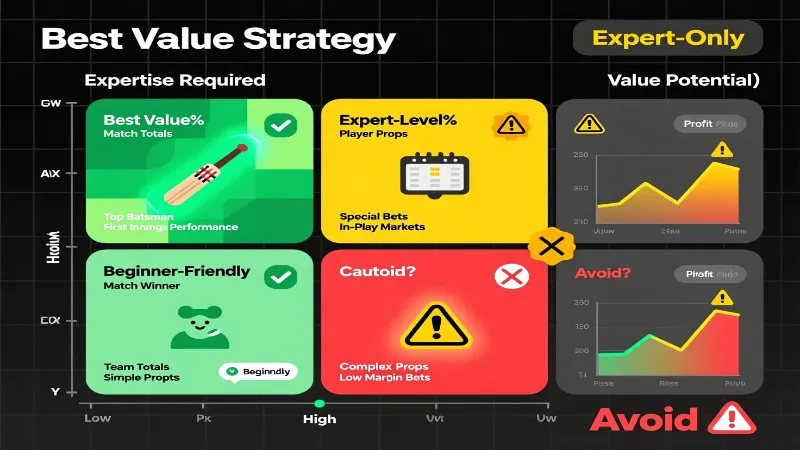
The key insight is not all markets offer equal value. Match winner markets are efficiently priced. Player props and niche markets contain inefficiencies. Understanding where value lives in cricket betting directs your focus toward profitable opportunities and away from markets designed to extract money from casual bettors.
Focus your analysis on markets where you can develop genuine expertise. If you obsessively track player form and matchups, player performance markets are your edge. If you understand pitch behavior and conditions deeply, totals and sessions markets offer value. If you watch matches live and can read momentum, live betting markets reward your attention. Spreading yourself across every available market dilutes expertise and reduces profitability.
Avoid exotic markets that exist primarily for entertainment. Next ball results, specific dismissal methods, combining multiple outcomes—these markets have wide bookmaker margins and minimal predictability. They're designed to appeal to recreational bettors seeking action and high odds, not to provide value. If something feels like a lottery ticket with slightly informed guessing, it probably is.
Track results by market type, not just overall profit and loss. You might be profitable overall but discover you're winning in player props while losing in match winners. This reveals where your actual edge exists versus where you think it exists. Double down on markets where you're genuinely profitable and eliminate or reduce markets where you're losing despite thinking you understand them.
The best cricket bettors specialize in two or three market types across one or two formats. They become experts in those narrow areas rather than generalists across all markets. That depth of expertise compounds over time, creating genuine edges that overcome bookmaker margins. Breadth might feel like you're maximizing opportunities, but depth is what creates long-term profitability.
Find top tips on our homepage.
