


1
Cricket isn't just a sport—it's a phenomenon that captivates over 2.5 billion people worldwide. From the five-day Test match marathons in England to the explosive T20 leagues lighting up stadiums in India, cricket offers something most other sports can't match: endless betting opportunities that run year-round.
If you've ever watched a match and thought about putting money on the outcome, you're not alone. Cricket betting has evolved from backroom bookies to sophisticated online platforms offering hundreds of markets for every single match. The beauty of betting on cricket lies in its complexity. Unlike football where you're mostly limited to win-draw-win, cricket gives you dozens of ways to find an edge—from predicting the top batsman to wagering on how many runs get scored in the next six balls.
Cricket betting rewards patience, research, and discipline. The matches are long enough that you have time to think. The statistics are rich enough that patterns emerge. The formats are varied enough that you can specialize. And the bookmakers make enough mistakes that sharp bettors can consistently find edges. Whether you're interested in Test cricket's strategic depth, the chaos of T20 leagues, or anything in between, there's a profitable approach waiting to be discovered.
Let's get started.
Cricket Betting Fundamentals: What You Need to Know Before You Start
What is Cricket Betting?
At its core, cricket betting means risking money on the outcome of cricket matches or specific events within those matches. You predict something will happen, stake money on that prediction, and either win based on the odds offered or lose your stake. Simple enough, right? But modern cricket betting has evolved far beyond just picking which team wins.
Cricket betting has also become more data-driven. Professional bettors use statistical models, pitch reports, weather forecasts, and historical data to make decisions. The information advantage that bookmakers once held has narrowed significantly. If you're willing to do the work, you can analyze matches as well as most oddsmakers do. That's both the opportunity and the challenge of modern cricket betting—the tools are available, but you need to use them properly.
Why Cricket is Perfect for Betting
Cricket's structure makes it uniquely suited to betting in ways that frustrate newcomers but delight experienced punters. The length of matches gives you time to think, research, and place considered bets rather than making snap decisions. A Test match unfolds over five days. Even a T20 game lasts three hours with natural breaks between overs. You're never rushed.
The final reason cricket works for betting is the bookmaker edge varies significantly by market. Match winner bets on major internationals might have tight margins with efficient odds, but obscure prop bets or matches in smaller leagues often contain pricing errors. Sharp bettors who know where to look can find value that simply doesn't exist in more efficient betting markets like Premier League football.
Legal Considerations
Cricket betting's legality varies dramatically depending on where you live. Some countries have fully regulated online betting markets with licensed bookmakers. Others prohibit all forms of gambling. Many fall somewhere in between—technically illegal but widely tolerated. I'm not a lawyer and this isn't legal advice, but you need to understand your local laws before placing a single bet.
The key factor is licensed bookmakers versus unregulated operators. Licensed sportsbooks operate under government oversight with consumer protections, regulated odds, and dispute resolution processes. They hold proper gambling licenses from jurisdictions like the UK, Malta, or Curacao. Unlicensed bookmakers might offer better odds or bonuses, but you have zero recourse if they decide not to pay your winnings or disappear entirely.
The offshore versus onshore question matters too. Offshore bookmakers licensed in betting-friendly jurisdictions often have fewer restrictions and better odds than locally regulated operators that pay higher taxes. But they may not accept customers from all countries, and some payment processors block transactions to gambling sites. Research which bookmakers accept customers from your location and have solid reputations for actually paying out winnings.
Understanding Cricket Odds: Reading the Numbers

Understanding different odds formats is essential for successful cricket betting
Types of Odds Formats
Bookmakers express odds in three main formats, and understanding all three helps you compare across different sportsbooks and calculate potential returns quickly. Decimal odds, fractional odds, and American odds all convey the same information—they just package it differently.
Decimal odds are the simplest and most common internationally. The number represents your total return including your stake. If India is 1.75 to beat England, a £100 bet returns £175 total—your £100 stake plus £75 profit. Easy math, clear returns, no conversion needed. Most European and Asian bookmakers use decimal odds as the default.
Most betting sites let you choose your preferred odds display format in settings. Pick whichever makes most sense to you and stick with it for consistency. Decimal odds get my recommendation for simplicity, but if you grew up with fractional odds, there's no compelling reason to switch.
What Odds Tell You
Odds aren't just about potential returns—they contain information about probability and bookmaker confidence. Short odds indicate the bookmaker believes something is likely to happen. Long odds suggest it's unlikely. A team at 1.20 is heavily favored. A team at 5.00 is a significant underdog. Understanding implied probability helps you identify value bets.
Converting odds to implied probability reveals what the bookmaker thinks will happen. With decimal odds, divide 1 by the odds. Odds of 2.00 equal 50% implied probability (1 ÷ 2.00 = 0.50). Odds of 3.00 equal 33.3% probability. Odds of 1.50 equal 66.7% probability. If you believe the actual probability differs from what the odds suggest, you've potentially found value.
Odds also move based on betting volume and new information. If heavy money comes in on India to win, bookmakers lower India's odds and raise the opponent's odds to balance their liability. Team news, pitch reports, or weather forecasts can shift odds dramatically. Smart bettors watch line movement to identify when sharp money is moving odds and try to get in before the value disappears. But don't fall into the trap of chasing steam—odds moving doesn't automatically mean sharp bettors are behind the movement. Sometimes it's just public money creating false signals.
Calculating Potential Returns
Calculating returns prevents surprises and helps you understand risk versus reward. With decimal odds, multiply your stake by the odds to get total return. A £50 bet at 2.50 returns £125 total (£50 × 2.50). Subtract your stake to find profit: £125 - £50 = £75 profit. Simple multiplication tells you exactly what you stand to win.
With fractional odds, divide the first number by the second and multiply by your stake to find profit. Odds of 5/2 on a £100 bet: (5 ÷ 2) × £100 = £250 profit. Add your stake back for total return: £250 + £100 = £350 total. The calculation takes an extra step but gives the same information.
American odds require different calculations for favorites versus underdogs. For negative odds (favorites), divide 100 by the odds (ignoring the minus) and multiply by stake. Odds of -150 on £75: (100 ÷ 150) × £75 = £50 profit. For positive odds (underdogs), divide odds by 100 and multiply by stake. Odds of +200 on £75: (200 ÷ 100) × £75 = £150 profit. The mental math is harder, which is why I prefer decimal odds.
Cricket Formats and How They Impact Your Bets
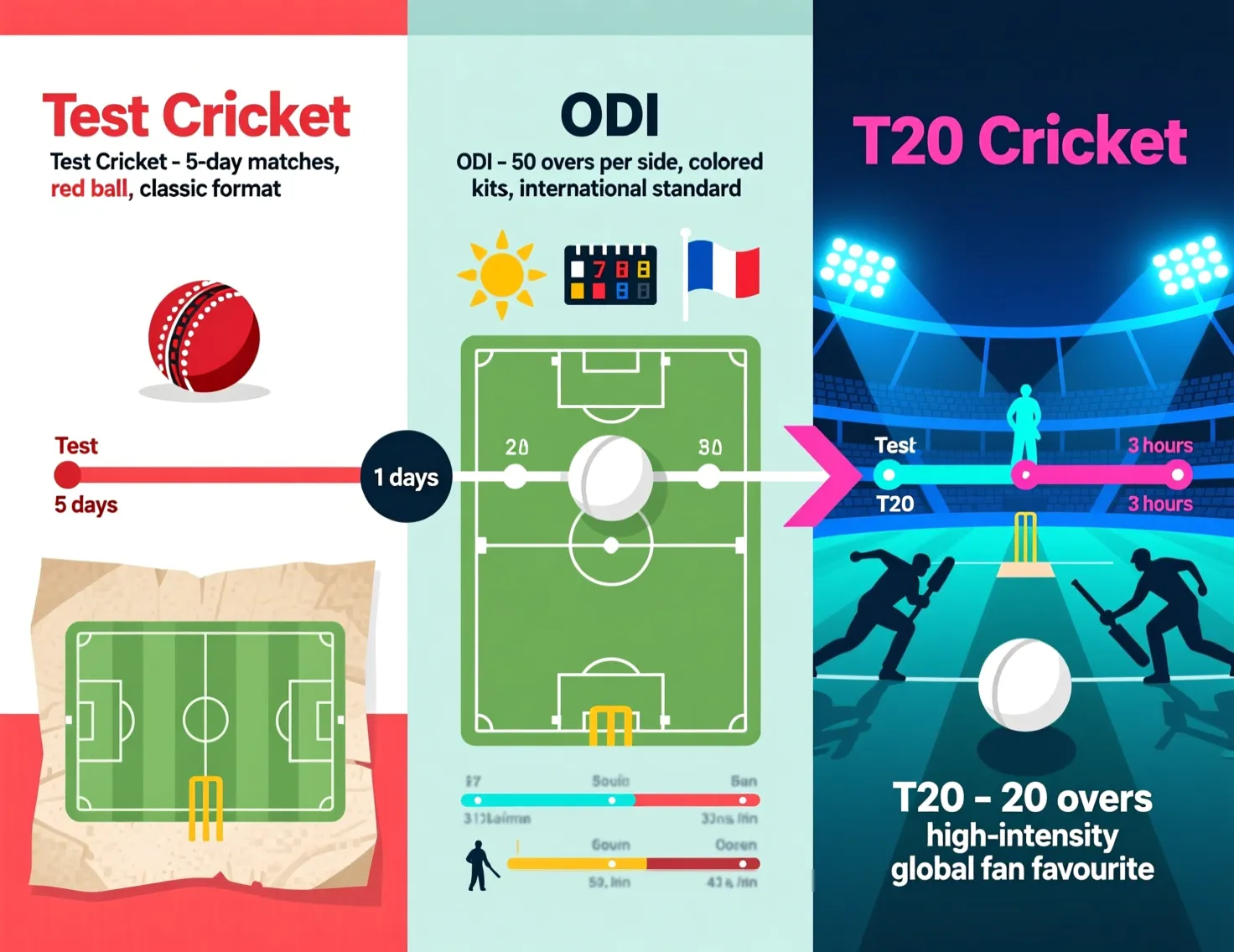
Each cricket format offers unique betting opportunities and challenges
Test Cricket Betting
Test cricket—five days of strategic chess disguised as sport. For betting purposes, Tests offer unique opportunities unavailable in shorter formats. The length allows for dramatic momentum swings. Teams can recover from terrible positions. Weather becomes a major factor. Draw results add a third outcome beyond win/lose. Understanding these dynamics is essential for profitable Test betting.
Session betting breaks Tests into manageable chunks. You can bet on runs scored in a session, wickets taken, or which team "wins" the session. Morning sessions often favor bowlers with fresh pitches and atmospheric conditions. Afternoon sessions see more runs as pitches flatten and bowlers tire. Final sessions can be attritional or aggressive depending on match situation. Each session is almost a mini-match with distinct characteristics.
Draw betting requires understanding match context and conditions. Some pitches deteriorate and guarantee results. Others remain flat for five days, making draws likely. Weather forecasts matter enormously—lost playing time increases draw probability. Team strategies affect draw likelihood too. Teams with commanding positions might declare aggressively seeking wins. Teams in trouble might bat defensively seeking draws. The draw odds often contain value because casual bettors hate betting on "boring" outcomes.
ODI Cricket Betting
One Day Internationals occupy the middle ground—longer than T20s but shorter than Tests. Fifty overs per side creates different strategic considerations. Teams can recover from poor starts. Individual brilliance matters but team depth is crucial. Weather interruptions invoke Duckworth-Lewis calculations that completely change match dynamics. Understanding these factors helps identify betting opportunities.
Innings runs betting in ODIs follows predictable patterns. First innings scores depend heavily on pitch conditions and batting first versus second preferences. Scores of 250-280 are par on most pitches. But some grounds consistently produce 300+ scores while others struggle to reach 230. Research ground history and recent matches to identify whether bookmaker totals lines accurately reflect local conditions.
Top batsman and bowler markets in ODIs reward research. Opening batsmen get full opportunity to score big but face the new ball. Middle order batsmen might not bat if openers excel. Bowlers who bowl at the death often collect wickets but also get punished. Spinners dominate on turning pitches but struggle on seaming tracks. These markets often have generous odds because predicting individual performance is inherently difficult.
T20 Cricket Betting
Twenty20 cricket revolutionized the sport and created new betting markets. Matches last three hours. Every ball matters. Momentum shifts rapidly. Individual brilliance can single-handedly win matches. The format's volatility creates both opportunities and dangers for bettors. Understanding T20 dynamics helps navigate this chaos profitably.
Powerplay betting exploits T20's structural phases. The first six overs have fielding restrictions that encourage aggressive batting. Teams average 45-55 runs but range from 20 to 90. Middle overs see consolidation with spinners operating. Death overs bring maximum chaos with 10-15 runs per over common. Each phase offers different betting opportunities. Bookmakers sometimes misprice these markets, especially in lesser-known leagues.
Live betting thrives in T20 cricket. Odds swing dramatically over by over. A couple of wickets or a big over completely changes match probabilities. The key is understanding momentum and match-ups. Some batsmen destroy spin but struggle against pace. Some bowlers excel at the death but get hammered in powerplays. Live betting lets you exploit this information as matches unfold.
Complete Cricket Betting Markets Breakdown
Match Result Markets
Match winner remains the most popular cricket bet for good reason. You're predicting which team wins—simple conceptually but complex analytically. Home advantage matters enormously in cricket. Familiar conditions, supportive crowds, and favorable umpiring decisions help home teams. But don't blindly back home teams. Sharp bettors identify when home advantage is already priced into odds versus when bookmakers undervalue it.
Double chance betting offers insurance by combining two outcomes. You can back Team A or Draw, Team B or Draw, or Team A or Team B (which only makes sense in Tests where draws are possible). Lower odds reflect lower risk. This market works well when you fancy an underdog but want protection against draws or when rain threatens to affect results.
Draw no bet removes the draw outcome, returning stakes if matches are drawn. In Tests, this protects against the frustration of correct winner picks ruined by weather or defensive play. The odds are lower than backing teams outright, but the insurance is often worthwhile on rain-affected matches or flat pitches where draws become likely.
Runs and Totals Markets
Total runs over/under might be cricket's best betting market for analytical bettors. You're predicting whether combined runs exceed or fall below bookmaker projections. Pitch conditions, weather, team strengths, and ground dimensions all matter. But unlike match results, you don't need to pick winners. Both teams can contribute to winning over bets or losing under bets.
Team totals isolate one team's scoring. This removes some variables—you only need to analyze one batting lineup versus one bowling attack. But it adds complexity because team totals depend partly on match situation. Teams batting first set targets. Teams batting second chase them. The psychology differs, affecting scoring rates and risk-taking.
Odd/even runs is pure gambling with no analytical edge possible. Whether a team scores 267 or 268 runs is random. These markets exist to attract recreational bettors who enjoy the coin-flip nature. Avoid these unless you're betting purely for entertainment. The house edge is built into the odds with no way to overcome it through research or skill.
Player Performance Markets
Top batsman betting requires understanding batting orders, match-ups, and conditions. Opening batsmen face more deliveries, increasing scoring opportunities. But they also face fresh bowlers with new balls. Middle-order batsmen might not bat if top-order excels. Lower-order batsmen rarely win unless batting first in low-scoring matches. Research career records at specific grounds—some batsmen love certain venues.
Top bowler markets are even more complex. Pace bowlers thrive on green, seaming pitches. Spinners dominate on dry, turning tracks. Death bowlers collect wickets but also get punished for runs. New ball bowlers get early wickets but might not bowl at the death. Conditions matter enormously—what works in Manchester fails in Mumbai.
Man of the match betting combines multiple factors. All-rounders have advantages through multiple contribution routes. But specialists who excel can win through singular brilliance. Match situation matters—winning team players get preference. Close matches favor match-winners. Demolitions favor stat-padders. These markets often have generous odds because prediction is genuinely difficult.
Winning Cricket Betting Strategies That Actually Work
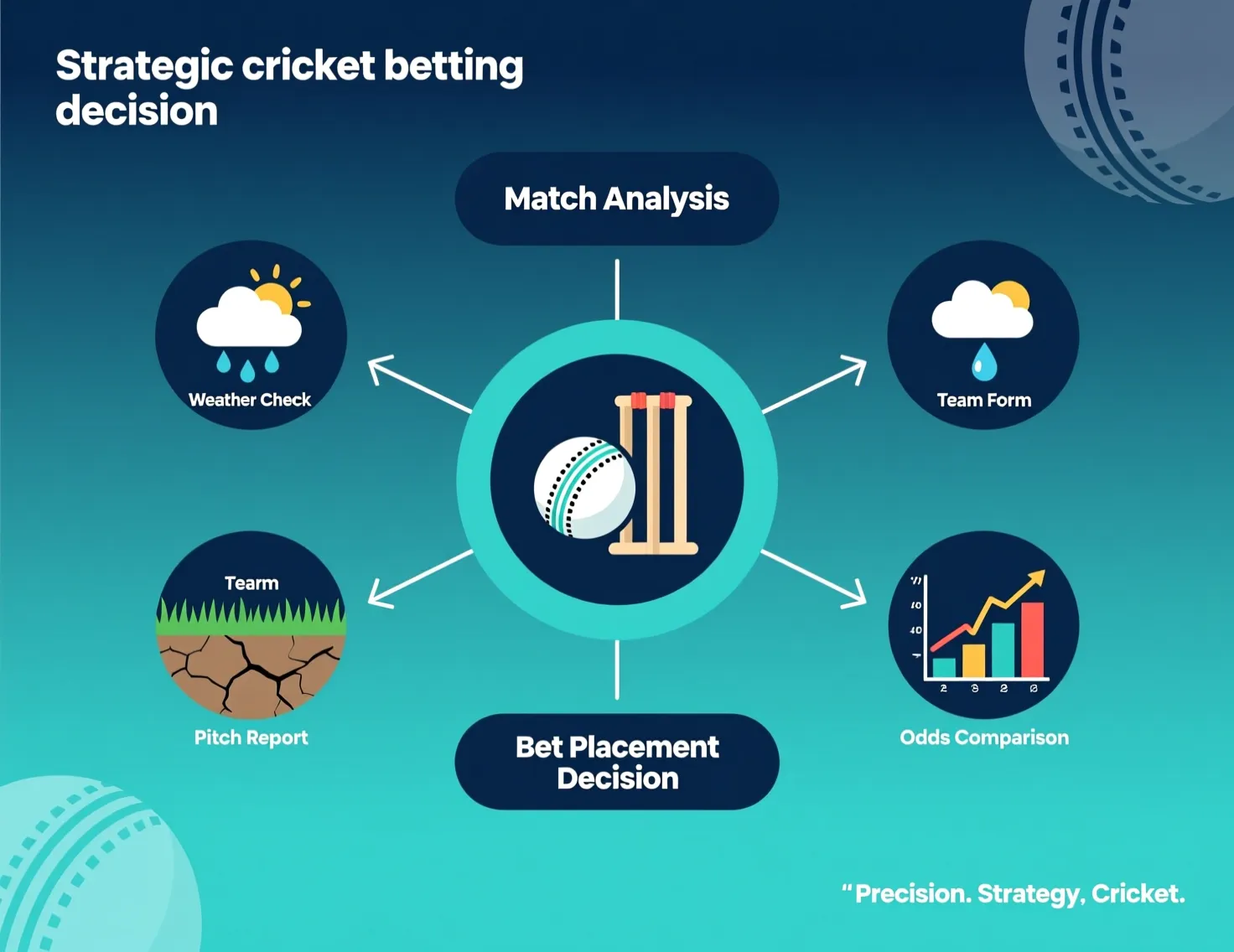
Follow a systematic approach for consistent betting success
Value Betting Approach
Value betting means finding odds that exceed true probability. If you believe India has a 60% chance of winning but bookmakers offer 2.00 odds (50% implied probability), you've found value. Long-term profit comes from consistently identifying and betting these discrepancies. You won't win every value bet—that's not the point. You'll win more than the odds suggest over time, generating profit.
Identifying value requires developing your own probability assessments. This means researching teams, conditions, and matchups to determine likely outcomes. Then compare your probabilities to bookmaker odds. If your assessment shows 70% win probability but odds imply 60%, you've potentially found value. The key word is "potentially"—your assessments must be accurate for this to work.
The challenge is most bettors overestimate their assessment accuracy. Everyone thinks they spot value, but most are seeing mirages. Track your bets meticulously. After 100+ bets, analyze whether your "value" bets actually won more often than odds suggested. If not, your assessments need work. Value betting only works if you genuinely identify mispriced odds, not if you merely think you do.
Specialization Strategy
Specializing beats generalization in cricket betting. The sport is too vast for anyone to expertly analyze every format, league, and market. Pick a niche and master it completely. Maybe you focus on IPL matches. Or Test cricket in England. Or Bangladesh domestic T20. Whatever you choose, become the expert who knows more than bookmakers about that specific area.
Specialization creates information advantages. If you follow Karnataka's Ranji Trophy team religiously, you'll know things casual observers miss. Which players are in form? Who's carrying injuries? How does the team perform in specific conditions? This granular knowledge helps identify mispriced odds. Bookmakers can't dedicate equal attention to every match. They focus on high-volume markets and estimate the rest.
Start with one format in one country. Follow every match, read every report, track every statistic. Build a database of results, conditions, and outcomes. After a season, you'll understand patterns invisible to casual observers. Then carefully expand—maybe add another league or format. But resist the temptation to bet everything. Expertise in one area beats superficial knowledge of many.
Arbitrage Opportunities
Arbitrage betting exploits odds discrepancies between bookmakers to guarantee profit regardless of outcome. If Bet365 offers India at 2.10 and William Hill offers Australia at 2.10, you can back both and profit regardless of who wins. These opportunities are rare and usually involve small edges, but they're risk-free when executed correctly.
Finding arbitrage requires comparing odds across multiple bookmakers quickly. Odds comparison sites help, but the best opportunities disappear within minutes. You need accounts at many bookmakers, funds distributed across them, and the ability to place bets rapidly. It's labor-intensive for small returns—typically 1-3% profit per arbitrage.
The bigger challenge is bookmakers hate arbitrage bettors. They'll limit or close accounts that only bet arbitrage opportunities. To maintain account longevity, mix in regular bets alongside arbitrage. Accept that this is likely a short-term strategy unless you're sophisticated enough to disguise your arbitrage activity. But even limited arbitrage can build bankroll risk-free.
Live Betting Tactics
Live betting offers advantages unavailable pre-match. You can watch conditions, assess momentum, and react to events. But it also requires quick decisions and emotional control. The key is having frameworks for common situations rather than making impulsive decisions. Preparation beats instinct in live betting.
One effective approach is betting against overreactions. When a team loses quick wickets, odds swing dramatically—often too far. If India falls to 20/3 chasing 160 in a T20, their odds might balloon from 1.80 to 4.00. But if they have quality middle-order batsmen and the required rate is manageable, 4.00 might offer value. Markets overreact to visible events while underweighting underlying match situation.
Interactive tool
Chase Calculator & Rain Target
Price a run chase from the actual match state, and see what a shortened innings really does to the equation.
Chance the chase gets home
-
-
Fair price
-
Required rate
-
Batting resources left
-
How the price moves with the next few overs
What drives the number: a chase is priced off two things, the runs still required and the batting resources still in hand. Resources combine balls remaining with wickets standing, which is why losing three early is far more damaging than the scoreboard suggests, and why a side four down with overs to spare is in better shape than the run rate implies.
Revised target
-
-
Rate before
-
Rate after
-
Who it favours
-
The same interruption at different lengths
On the method: this follows the published resource approach, scaling the target by the share of batting resources each side actually received. The official tables used by match officials are proprietary and this is a close approximation rather than a reproduction of them, so treat the figures as a guide to how the revision will move rather than an exact settlement.
Another tactic is targeting specific match phases. Maybe you specialize in death bowling overs, understanding which bowlers excel under pressure. Or powerplay batting, knowing which openers start fast versus slow. Having expertise in specific phases lets you spot value as matches enter your specialty area. You don't need to bet entire matches—just the parts you understand best.
Reading the Game: Factors That Influence Cricket Matches

Pitch conditions dramatically affect match outcomes and betting decisions
Weather and Conditions
Weather affects cricket more than any other major sport. Rain obviously stops play, but humidity, cloud cover, wind, and temperature all influence matches subtly. Overcast conditions help swing bowlers by providing atmospheric moisture. Hot, dry weather assists spin bowlers by creating dusty, crumbling pitches. Wind affects bowling accuracy and batting shot selection. Understanding weather's impact helps predict match flow.
Dew becomes crucial in day-night matches, particularly in the subcontinent. Evening dew makes the ball slippery and hard to grip, neutralizing spinners and making bowling difficult. Teams batting second gain huge advantages as dew settles. In the IPL, teams winning tosses often field first specifically because of dew factor. Check whether matches are day games or day-night affairs—it matters enormously for betting.
Rain interruptions create unique betting opportunities. In Tests, rain can force draws regardless of match position. In limited-overs cricket, Duckworth-Lewis-Stern calculations determine revised targets that can dramatically alter match dynamics. A team cruising to victory might suddenly face a much stiffer revised target. Weather forecasts are free information that many bettors ignore—use them to your advantage.
Team Form and Momentum
Current form matters more than historical records in cricket betting. A team that won 10 straight matches last year but lost their last 3 is probably struggling. Recent results reflect current team dynamics, confidence levels, and tactical approaches. Weight recent matches heavily, especially those in similar conditions against comparable opponents.
But don't blindly follow form. Understand why teams are winning or losing. Are they genuinely playing well or getting lucky? Are opponents particularly weak? Are conditions favoring their strengths? A team might have won five straight matches at home on turning pitches but could struggle away on seaming tracks. Context matters more than raw results.
Momentum within matches swings rapidly in cricket. A partnership can shift match control. A quick burst of wickets changes everything. But momentum is partly psychological—good teams resist momentum swings while weak teams crumble. Understanding which teams maintain composure under pressure versus which panic helps predict how matches unfold after key moments.
Head-to-Head Records and Matchups
Head-to-head records provide context but shouldn't dominate analysis. Australia might have beaten England 15 times in the last 20 matches, but if those matches were in Australia on bouncy pitches and the upcoming match is in England on a seaming track, the historical record means less. Use head-to-heads to understand psychological dynamics and matchup patterns, not as predictive tools.
Player matchups matter more than team records. Some batsmen consistently struggle against certain bowlers. Some bowlers repeatedly dismiss specific batsmen. These personal battles within matches can determine outcomes. If a team's best batsman averages 15 against the opponent's strike bowler, that's significant. Research individual matchups for edges bookmakers might miss.
Venue records reveal ground-specific patterns. Some teams excel at particular venues regardless of opponents. India at Eden Gardens. Australia at the Gabba. England at Lord's. These fortress venues provide genuine home advantages beyond normal home-away splits. Conversely, some teams consistently struggle at specific grounds. Factor venue history into analysis, especially for important matches.
Choosing the Right Cricket Betting Platform
Evaluating Bookmakers
Choosing bookmakers is like selecting banks—you want reliability, security, and good service. Licensing comes first. Only use bookmakers with legitimate gambling licenses from recognized jurisdictions. UK Gambling Commission, Malta Gaming Authority, or Curacao eGaming licenses indicate regulatory oversight. Unlicensed operators might offer better odds but risk not paying winnings.
Reputation matters enormously. Research bookmaker reviews focusing on withdrawal experiences, not bonus offers. Do they pay winnings promptly? Do they limit successful bettors quickly? Do they void bets on technicalities? Forums and review sites reveal patterns. A bookmaker with consistent payment complaints is avoiding regardless of their odds or bonuses.
Market variety determines betting options. Some bookmakers offer hundreds of cricket markets per match. Others provide basic match winner and totals. More markets mean more opportunities to find value. But don't sacrifice reliability for variety. Better to have fewer options at trustworthy bookmakers than endless markets at sketchy operators.
Understanding Betting Features
Cash out lets you settle bets before matches conclude, locking in profits or minimizing losses. If you backed India at 3.00 and they're now 1.50 favorites, cashing out guarantees profit without sweating the result. But cash out values are always worse than letting bets run or hedging yourself. Use it for convenience, not as a primary strategy.
Bet builders combine multiple selections from the same match into one bet. You might combine India to win, Kohli to score 50+, and total runs over 300. Higher odds reflect lower probability of multiple outcomes occurring. These bets are recreational fun but rarely offer value. Bookmakers love them because the margins multiply with each selection.
Live streaming changes the betting experience. Watching matches while betting helps you judge momentum and conditions better than following text commentary. Some bookmakers offer free streaming to customers with funded accounts or placed bets. This feature adds genuine value if you bet live regularly. Just beware the slight delay—live odds might update before your stream catches up.
Payment Methods and Security
Deposit and withdrawal methods affect your betting experience significantly. Credit cards work everywhere but some banks block gambling transactions. E-wallets like PayPal, Skrill, or Neteller process quickly but charge fees. Bank transfers are secure but slow. Cryptocurrency offers anonymity but volatility. Choose methods that balance speed, cost, and convenience for your situation.
Security goes beyond payment methods. Use unique, strong passwords for each bookmaker account. Enable two-factor authentication where available. Never share account details or bet on public WiFi without VPN protection. Treat bookmaker accounts like bank accounts—because that's essentially what they become once funded.
Beware of problem gambling signs. Set deposit limits before you need them. Use cooling-off periods if betting becomes compulsive. Self-exclude if necessary. Every legitimate bookmaker offers responsible gambling tools. Using them isn't weakness—it's smart risk management. Protect yourself from yourself when needed.
Major Cricket Events & Tournaments Worth Betting On
ICC World Cups
The Cricket World Cup remains the pinnacle tournament, occurring every four years. Fifty-over format, ten teams, round-robin into knockouts. The extended format reduces variance—best teams usually progress. But upsets happen. Betting opportunities multiply during the six-week tournament with matches daily. Focus on specific matchups rather than outright winners unless you spot significant value early.
T20 World Cup happens every two years with more teams and shorter matches. The format's volatility makes favorites vulnerable. Any team can beat anyone on their day in T20. This creates betting opportunities as bookmakers often overprice favorites based on reputation rather than T20-specific form. Look for value on unfancied teams with strong T20 records.
Champions Trophy features the top eight ranked teams in 50-over format. It's essentially a mini World Cup with higher quality throughout—no minnows to pad stats against. Matches are competitive, making handicap and totals betting attractive. The condensed format means form and momentum matter enormously. Teams that start well often maintain momentum through the short tournament.
Franchise Leagues
Indian Premier League dominates franchise cricket. Two months of daily matches create endless betting opportunities. The auction system spreads talent relatively evenly, making most matches competitive. But don't assume parity—some franchises consistently outperform through superior coaching, tactics, and team chemistry. Study three-year trends, not just current seasons.
Big Bash League in Australia offers prime-time cricket during the Northern Hemisphere winter. The quality is high, grounds are batting-friendly, and matches are televised globally. BBL markets often have better odds than IPL because lower betting volumes reduce bookmaker attention. If you understand Australian conditions, BBL offers excellent value opportunities.
Other T20 leagues proliferate globally—PSL in Pakistan, CPL in the Caribbean, Hundred in England, LPL in Sri Lanka. Each has unique characteristics. Some favor bowlers, others batsmen. Some have dominant teams, others are unpredictable. Specializing in one lesser-followed league can be profitable as bookmakers pay less attention to getting odds perfect.
Bilateral Series
Test series between major nations remain cricket's traditional pinnacle. The Ashes, Border-Gavaskar Trophy, and other iconic series attract huge betting interest. Home advantage is massive in Test cricket—teams familiar with conditions dominate. But don't write off strong touring teams entirely. Value often exists in backing tourists to win at least one Test when priced as series no-hopers.
ODI series have declined in importance but still offer betting value. Bilateral ODI series often see experimentation as teams prepare for world events. This creates opportunities if you identify which teams are taking series seriously versus treating them as practice. Watch team selections—full-strength sides indicate intent.
T20 internationals are almost exhibition matches outside world cups. Teams rotate players, experiment with combinations, and rarely show full intensity. This randomness makes T20I betting challenging but can create value if you identify motivation disparities. A team fighting for rankings points versus one already qualified for a tournament might offer unexpected value.
Common Cricket Betting Mistakes to Avoid
Emotional Betting and Bias
Backing your favorite team regardless of odds or situation is betting's most common mistake and the hardest to overcome. Emotional attachment clouds judgment, causing you to overestimate your team's chances and underestimate opponents. Successful betting requires objectivity—treating teams as probabilities rather than emotional investments.
The problem isn't occasional bets on your team—that's entertainment. The problem is consistently overvaluing your team's prospects and making unprofitable bets as a result. If India is your favorite team and you bet on them in every match, you're guaranteed to make negative expected value bets whenever they're overpriced. Bookmakers know fan loyalty creates betting patterns and price popular teams accordingly, often creating value on their opponents.
Ignoring Conditions and Research
Betting cricket without checking pitch reports and weather forecasts is like navigating without a map. Conditions fundamentally determine match outcomes, yet many bettors ignore them entirely or give them token consideration. This is lazy betting that bookmakers exploit mercilessly. The information is freely available—use it.
Assuming all cricket pitches play the same is embarrassingly naive but surprisingly common among casual bettors. A green pitch in Manchester behaves nothing like a dry turner in Chennai. Expecting 300-plus totals on a seaming wicket causes expensive mistakes. Fifteen minutes of pitch research before betting prevents these errors. Look at ground history, recent pitch behavior, curator comments, and weather conditions affecting preparation.
Chasing Losses and Poor Bankroll Management
Increasing stakes after losses trying to quickly recover is the most common path to betting failure. This violates every principle of sound bankroll management and turns temporary bad runs into catastrophic losses. Variance means losing streaks happen even with positive expected value betting. If you increase stakes during losing streaks, you're amplifying the damage variance causes while your judgment is potentially impaired by frustration.
Betting too much on single bets creates risk of ruin. Even if you're betting profitably, normal variance will produce losing streaks that destroy poorly-managed bankrolls. If you're risking 20% of your bankroll on single bets, a three-bet losing streak—completely normal and expected—costs 60% of your capital. Recovery from these drawdowns is mathematically difficult and psychologically draining. Limiting single bet risk to 5% maximum of bankroll keeps you in the game through inevitable variance swings.
Responsible Cricket Betting: Playing it Safe

Always bet responsibly and within your means
Setting Limits and Boundaries
Successful betting requires strict boundaries established before emotions interfere. Set a monthly betting budget that won't affect your life if lost completely. This isn't pessimism—it's risk management. Treat betting as entertainment expense like cinema tickets or restaurant meals. If you can't afford to lose it, don't bet it.
Time limits matter as much as financial limits. Spending eight hours daily analyzing cricket and betting isn't healthy regardless of profitability. Set specific times for betting activity. Maybe two hours on weekends for research and placing bets. Boundaries prevent betting from consuming your life even when you're winning.
Loss limits protect against tilt—the poker term for emotionally compromised decision-making after losses. Decide beforehand how much you're willing to lose in a day, week, or month. When you hit that limit, stop immediately regardless of how confident you feel about the next bet. Tomorrow brings new opportunities with clear thinking.
Bankroll Management Essentials
Professional betting requires professional money management. Separate betting funds from life expenses completely. Create a dedicated betting bankroll that won't impact your life if it disappears. This removes pressure and enables rational decision-making. Scared money makes bad decisions.
Unit sizing keeps bets proportional to bankroll. Most professionals risk 1-2% of bankroll per bet. Confident bets might warrant 3-5%. Never exceed 5% on a single bet regardless of confidence. This might seem conservative, but it ensures survival through losing streaks. You can't profit if you're bankrupt.
Record keeping reveals reality that memory distorts. Track every bet—date, match, market, stake, odds, result, profit/loss. Review monthly to identify patterns. Are you profitable? Which markets work? Which don't? What's your actual ROI? Data doesn't lie. If you're not willing to track results honestly, you're not serious about profitable betting.
Recognizing Problem Gambling
Problem gambling creeps up gradually. What starts as entertainment becomes compulsion. Warning signs include betting more than intended, chasing losses, lying about betting, borrowing money to bet, or betting interfering with relationships or work. Recognizing these signs early enables intervention before serious damage occurs.
If betting stops being fun, stop betting. If you're anxious about bet outcomes, angry after losses, or constantly thinking about betting, you've crossed from entertainment to problem territory. These emotional responses indicate unhealthy attachment to gambling outcomes. Take a break—self-exclude if necessary.
Help exists if you're struggling. Every country has gambling addiction resources. Hotlines, counseling, support groups, and self-exclusion programs are available. Using them isn't admitting failure—it's taking control. Problem gambling is addiction like any other. Treatment works if you seek it. Your wellbeing matters more than any bet.
Frequently Asked Questions
Q: How do you bet on cricket for beginners?
Start by opening an account with a licensed bookmaker. Deposit a small amount you can afford to lose—maybe £50 to £100. Begin with simple match winner bets on cricket formats you understand. If you watch T20 leagues, start betting T20 match winners. If you follow Test cricket, bet Test match winners. Focus on one format initially rather than betting everything.
Research teams and conditions before betting. Check recent form, pitch reports, and weather forecasts. These factors dramatically affect outcomes but many beginners ignore them. Set a budget for each match—maybe 2-5% of your total bankroll. Never bet more than you've allocated for that match regardless of confidence level.
Track every bet in a spreadsheet—stake, odds, outcome, profit/loss, and reasoning. After 20-30 bets, analyze results. Are you profitable? If not, why? Are you betting poorly on certain bet types or formats? Data reveals patterns emotions hide. Adjust strategy based on evidence rather than hunches.
Learn continuously. Read betting guides, follow cricket analysts, and study statistics. The more you understand about cricket and betting, the better your decisions become. Start small, learn constantly, and don't expect instant success. Profitable betting is a skill developed over months and years, not days.
Q: What is the best cricket betting market to start with?
Match winner markets are ideal for beginners because they're conceptually simple and bookmakers price them efficiently. You're predicting which team wins the match—no complexity about runs, wickets, or player performances. The efficient pricing means you're competing on even footing with the market rather than trying to beat wide margins in exotic props.
Once comfortable with match winners, expand to totals betting—over/under on team runs or match runs. Totals require understanding conditions and pitch behavior but don't require predicting specific player performances or complex outcomes. You're judging whether scoring will be higher or lower than bookmaker expectations based on pitch, weather, and team batting strength.
Avoid player props and exotic bets initially. These markets have wider bookmaker margins and require detailed player knowledge and matchup analysis. Top batsman or top bowler bets might seem simple but are actually complex—batting order, matchups, conditions, and form all affect probabilities. Build foundational skills with match winners and totals before progressing to player markets.
Live betting is tempting for beginners but actually harder than pre-match betting. You need to read match flow, understand momentum shifts, and make quick decisions while emotions run high. Master pre-match betting first, then cautiously explore live betting once you've developed analytical frameworks and emotional control.
Q: How do weather and pitch conditions affect cricket bets?
Weather and pitch conditions are the most important non-team-quality variables in cricket betting. They directly determine whether matches favor batsmen or bowlers, high scoring or low scoring, results or draws. Ignoring conditions is like betting on outdoor sports without knowing if it's sunny or snowing.
Green pitches with grass coverage help fast bowlers extract seam movement, making batting difficult and totals lower. Flat, dry pitches are batting paradises with high scoring and longer innings. Dusty, cracking pitches assist spin bowlers dramatically, especially in later innings of Test matches. Research pitch history at specific grounds—some consistently produce certain characteristics.
Weather impacts matches multiple ways. Overcast conditions help swing bowling by providing atmospheric moisture. Rain interrupts play, potentially invoking Duckworth-Lewis in ODIs or creating draws in Tests. Evening dew in warm climates makes the ball slippery, helping teams batting second in T20s and ODIs. Wind affects batting tactics and bowling effectiveness. Check detailed weather forecasts before every bet, not just whether it might rain.
The combination of pitch and weather creates conditions that favor specific team and player types. If a team has three quality pace bowlers and the pitch is green with overcast conditions forecast, that team has significant advantage over opponents with weak pace bowling. Understanding how pitch and weather interact reveals edges bookmakers sometimes miss when setting odds.
Key Takeaways for Successful Cricket Betting
Cricket betting rewards knowledge, discipline, and patience. You're now equipped with frameworks for analyzing matches, understanding odds, selecting bookmakers, managing bankroll, and avoiding common mistakes. But reading a guide doesn't make you a profitable bettor—application and continuous learning do.
Start slowly with small stakes while building experience. Track results meticulously and adjust based on evidence rather than emotion. Specialize in formats, markets, or leagues where you can develop genuine expertise rather than betting everything superficially. Focus on finding value through research and analysis, not on predicting winners through guesswork.
The sport offers genuine opportunities for informed bettors willing to do the work. Whether you're betting casually for entertainment or seriously pursuing profit, the principles remain the same. Research thoroughly, bet selectively, manage risk carefully, and continuously improve your craft.
Now go watch some cricket. Pay attention to what you've learned. Notice how conditions affect play. Observe which bookmaker odds accurately reflect match state and which don't. Practice analyzing matches without betting to sharpen skills without risking money. When you're ready to bet, you'll do so with knowledge that separates you from casual punters feeding bookmaker profits.
Good luck. Bet responsibly. And may your bets be ever +EV.
