
Cricket Arbitrage Betting: Guaranteed Profit Strategies
 Available in US
Arbitrage betting exploits odds discrepancies between bookmakers to guarantee profit regardless of outcome. When one bookmaker offers India at 2.20 while another offers Australia at 2.00 in the same match, betting both sides appropriately produces profit no matter who wins. This mathematical certainty distinguishes arbitrage from value betting, where you're still exposed to losing individual bets despite positive expected value.
The catch is that pure arbitrage opportunities are rare, small in margin, and quickly disappear as bookmakers monitor and close gaps. But understanding arbitrage concepts—even if you never execute pure arbitrage—improves your betting by revealing how odds relate across bookmakers and how markets price different outcomes.
How Arbitrage Works Mathematically
Arbitrage requires odds that sum to less than 100% implied probability when combined optimally. Most markets sum to more than 100%—the excess is the bookmaker's margin. When combined odds from different bookmakers sum to less than 100%, arbitrage exists.
The calculation involves comparing implied probabilities across bookmakers. India at 2.20 implies 45.5% probability. Australia at 2.00 implies 50% probability. Combined implied probability: 45.5% + 50% = 95.5%. Since this falls below 100%, arbitrage exists. The 4.5% gap represents guaranteed profit when stakes are sized correctly.
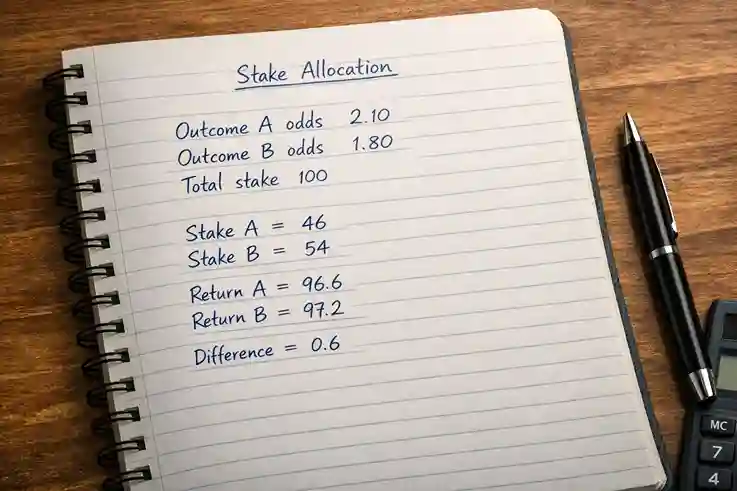
Correct stake allocation divides total stake inversely proportional to odds. If betting 100 total units, stake on India: 100 × (1/2.20) / ((1/2.20) + (1/2.00)) = 100 × 0.455 / 0.955 = 47.6 units. Stake on Australia: 100 × (1/2.00) / ((1/2.20) + (1/2.00)) = 100 × 0.50 / 0.955 = 52.4 units. If India wins: 47.6 × 2.20 = 104.7 return. If Australia wins: 52.4 × 2.00 = 104.8 return. Either outcome returns more than the 100 units staked.
The guaranteed profit margin is small—in this example, roughly 4.7% regardless of outcome. But crucially, it's guaranteed. No analysis required, no risk of losing. Pure arbitrage is mathematical exploitation of pricing inefficiency rather than prediction.
Finding Arbitrage Opportunities
Arbitrage opportunities arise when bookmakers disagree about outcome probabilities or when one bookmaker's odds drift while others haven't adjusted. Finding these opportunities requires systematic monitoring across many bookmakers.
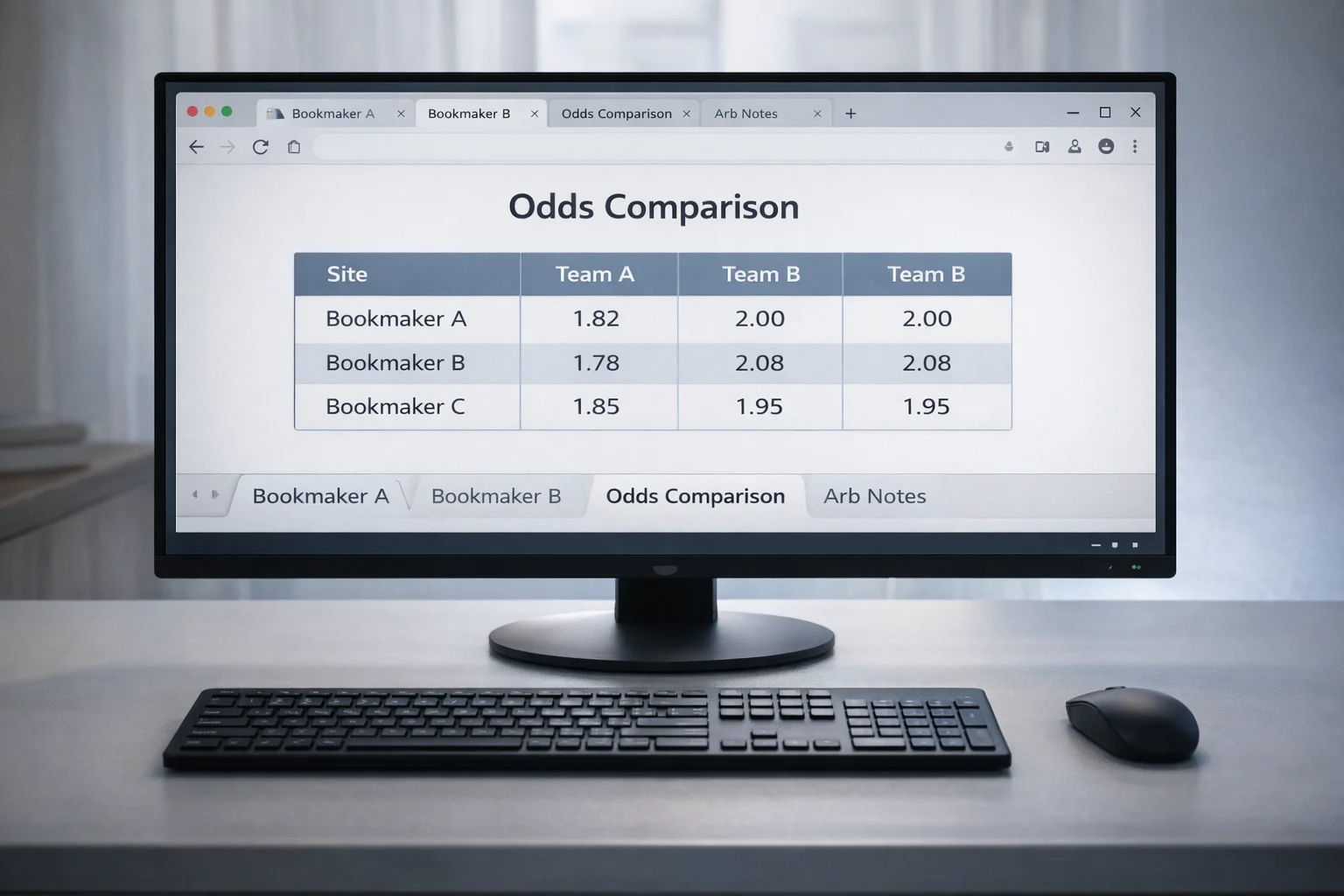
Odds comparison websites provide starting points. Sites that aggregate odds from multiple bookmakers let you quickly spot price discrepancies. When you see the same outcome priced significantly differently across bookmakers, check whether arbitrage exists by calculating combined implied probabilities.
Betting exchanges create arbitrage possibilities against traditional bookmakers. Exchange odds, set by market supply and demand rather than bookmaker assessment, sometimes diverge from fixed-odds prices. The exchange might have India available to back at 2.30 while a bookmaker offers Australia at 1.95—combinations that might produce arbitrage when traditional bookmaker-versus-bookmaker comparisons don't.
Live betting produces more arbitrage opportunities than pre-match betting. Different bookmakers adjust live odds at different speeds after match events. When a wicket falls, one bookmaker might adjust instantly while another lags by seconds or minutes. These timing differences create brief arbitrage windows. However, live arbitrage demands fast execution and carries risk of one bet being placed while the other's odds change before you complete the second bet.
Practical Challenges
Pure arbitrage faces obstacles that limit its practical profitability. Understanding these challenges helps you decide whether arbitrage merits your time and resources.
Margins are typically small. Most arbitrage opportunities offer 1-3% guaranteed profit. A 1000-pound total stake might guarantee just 10-30 pounds profit. Generating significant income requires large capital deployed frequently across many opportunities. Transaction costs, time investment, and capital requirements often exceed returns for recreational bettors.
Bookmakers identify and restrict arbitrage bettors. Betting patterns that indicate arbitrage—betting both sides, always taking best available prices, betting unusual stake amounts to precise decimal places—flag accounts for review. Bookmakers respond by limiting maximum stakes or closing accounts entirely. Successful arbitrage bettors often see their accounts restricted at precisely the bookmakers offering the best prices.
Execution risk threatens live arbitrage. Placing one bet then finding the second bet's odds have changed leaves you exposed. You might be stuck with a single bet that you didn't want individually. This risk increases during volatile live markets where odds move rapidly. Delayed bet acceptance, stake restrictions, or technical glitches can all cause one leg of an arbitrage attempt to fail.
To apply these strategies, you need the best cricket betting sites.
Arbitrage Variations
Pure arbitrage isn't the only way to exploit odds discrepancies. Related strategies capture some arbitrage benefits while accepting some risk.
Matched betting uses bookmaker promotions to create arbitrage-like situations. Free bet offers, deposit bonuses, and odds boosts can be combined with exchange bets to guarantee profit or near-profit. If a bookmaker offers a 10-pound free bet, you can back with the free bet and lay on an exchange to extract the free bet's value regardless of outcome. This isn't pure arbitrage—it depends on promotional offers—but follows similar logic.
Value betting with hedging combines value identification with partial arbitrage. If you identify a value bet on India, you might also place a smaller bet on Australia at another bookmaker as insurance. The hedge reduces variance without eliminating the value—you might profit regardless of outcome while still capturing more profit if your value assessment proves correct.
Dutching involves betting multiple outcomes with the same bookmaker to guarantee returns if any selection wins. This isn't cross-bookmaker arbitrage but uses similar stake allocation logic. If three players are each priced at 4.00 for top batsman and you assess that one of these three will almost certainly win, dutching all three guarantees profit if any succeeds.
Exchange Arbitrage and Laying
Betting exchanges introduce "laying" bets—betting against outcomes rather than backing them. This mechanic creates arbitrage possibilities between backing and laying on the same exchange or between exchanges and traditional bookmakers.
Back-lay arbitrage on exchanges exploits bid-ask spreads. If you can back Team A at 2.10 and simultaneously lay Team A at 2.08, you're guaranteed a small profit regardless of whether Team A wins. The challenge is that back and lay prices usually don't permit this—the lay price is typically worse than the back price on the same outcome.
Cross-market arbitrage combines different market types. If top batsman odds imply different probabilities than match winner markets, combinations might guarantee profit. These situations are complex to identify and execute but occasionally arise when bookmakers price markets independently without ensuring cross-market consistency.
Exchange arbitrage faces liquidity constraints. Even when arbitrage-priced opportunities exist, sufficient liquidity to bet meaningful amounts might not be available. Getting matched on both sides of an arbitrage at required stake levels can be difficult, especially in less popular markets.
When Arbitrage Makes Sense
Despite challenges, certain situations make arbitrage worthwhile for some bettors.
New account bonuses create arbitrage opportunities. When opening accounts at new bookmakers, welcome bonuses effectively subsidize your bets. Using these bonuses for arbitrage captures their value while minimizing risk. Many professional matched bettors cycle through bookmaker bonuses using arbitrage-style strategies.
Large bankroll bettors can generate meaningful income from small percentage returns. If you can stake 10,000 pounds per opportunity with 1% guaranteed return, each arbitrage generates 100 pounds profit. Finding five such opportunities weekly produces 500 pounds. Whether this justifies the time, risk of account restrictions, and capital requirements depends on individual circumstances.
Arbitrage understanding improves non-arbitrage betting. Even if you never execute pure arbitrage, understanding why odds differ between bookmakers helps you find value. If Bookmaker A has India at 2.00 while Bookmaker B has 2.20, you know 2.20 is significantly better than market average. This odds comparison skill helps value betting even without the arbitrage completion.
Account Longevity and Sustainability
Preserving bookmaker accounts matters for any betting strategy, but especially for arbitrage-adjacent approaches. Account restrictions can terminate profitable strategies.
Vary your betting patterns to avoid obvious arbitrage signatures. Don't always bet precise amounts that suggest arbitrage calculation. Occasionally bet markets you'd bet anyway regardless of arbitrage opportunities. Spread activity across multiple bookmakers rather than concentrating on those with the best odds.
Accept that some accounts will eventually be restricted. This is the cost of doing business for arbitrage and advantage betting generally. When restrictions come, move on to remaining accounts and seek new bookmaker opportunities. Maintaining a pipeline of usable accounts sustains arbitrage approaches over time.
Consider whether time spent on arbitrage could more profitably go toward value betting or other approaches. Arbitrage returns are certain but small; value betting returns are uncertain but potentially larger. Your personal skills, capital, and risk tolerance should determine which approach receives more focus.
Secure risk-free profits with CricketBetTips.com.
