
Value Betting in Cricket: Finding Edge in the Odds
 Available in US
Value betting is the foundation of profitable gambling. The concept is simple: bet when the odds offered exceed the true probability of an outcome. If you consistently find and bet on value, you will profit over time regardless of individual results. If you consistently bet without value—backing selections at odds shorter than their true probability—you will lose regardless of how often you win. Every profitable betting career is built on this principle.
What makes value betting challenging is that it requires disagreeing with the market. Bookmakers employ traders, use sophisticated models, and have access to information that shapes their odds. When you identify value, you're asserting that you know something the market doesn't, or that you've assessed probabilities more accurately than professional oddsmakers. This assertion must be grounded in genuine analytical edge, not wishful thinking.
Understanding Value Mathematically
Value exists when your assessed probability of an outcome exceeds the implied probability of the odds offered. The calculation is straightforward but essential to internalize.
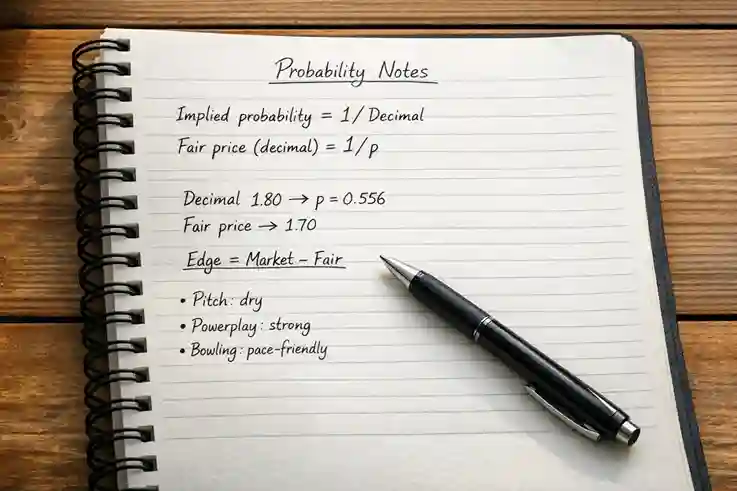
Implied probability converts odds into percentage chance. For decimal odds, divide 1 by the odds. Decimal 2.50 implies 40% probability (1/2.50 = 0.40). Decimal 1.80 implies 55.6% probability. Decimal 3.00 implies 33.3% probability. This conversion tells you what chance the bookmaker assigns to each outcome—and by extension, what chance you must exceed to find value.
If you assess India's probability of beating Australia at 50%, but the bookmaker offers 2.20 (implying 45.5%), you've identified value. Your edge is the gap between your assessment and the implied probability—in this case, roughly 4.5 percentage points. Betting at 2.20 when you believe true odds should be 2.00 captures that edge.
Expected value formalizes this mathematically. Multiply your assessed probability by potential profit, then subtract the probability of losing multiplied by stake. If India at 2.20 with a 10-pound stake represents 50% true probability: (0.50 × 12 profit) - (0.50 × 10 stake) = 6.00 - 5.00 = +1.00 expected value per bet. Positive expected value indicates profitable betting; negative expected value indicates unprofitable betting. Every bet you place should have positive expected value according to your analysis.
Sources of Value in Cricket
Value emerges when bookmaker assessments diverge from reality. Understanding why these divergences occur helps you find them systematically.
Bookmakers react to public sentiment, sometimes excessively. Popular teams attract public money that shortens their odds beyond justified levels. India's massive betting volumes mean their odds often compress due to fan loyalty rather than objective assessment. When public money piles onto favorites, the underpriced opposition represents value for those willing to bet against popular sentiment.
Injury and team news creates temporary value windows. When a key player is ruled out shortly before a match, bookmakers adjust odds—but not always fully or immediately. If you receive injury news quickly and assess its impact accurately, you can capture value before markets correct. This requires information sources that reach you before they reach the general betting public.
Condition-specific advantages get overlooked by bookmakers focused on overall team quality. A team might be mediocre generally but excellent in specific conditions—spinning pitches, swinging conditions, particular venues. If bookmakers price based on general strength rather than condition-specific form, the specialist team offers value in their favorable environments.
Format transitions create value when bookmakers don't fully adjust for format-specific factors. A team dominating T20 cricket might be overpriced in Tests if their T20 success drives odds without accounting for different skill requirements. Similarly, Test specialists might be underpriced in Tests when their recent ODI struggles have affected perception.
Developing Probability Assessments
Finding value requires knowing true probabilities—something that's inherently uncertain. Your assessments are estimates, but they must be rigorous estimates rather than gut feelings dressed up as analysis.
Build assessments from component factors. Rather than asking "Who will win this match?" directly, break the question into components: How will the pitch behave? Which bowling attack is better suited to conditions? How have these teams performed in similar situations recently? Which team's key players are in better form? Building overall probability from analyzed components produces more accurate assessments than holistic guessing.
Use historical base rates as starting points. What percentage of Test matches at this venue produce results versus draws? What percentage of ODI totals at this ground exceed 300? What percentage of home teams win this fixture historically? These base rates provide anchors that prevent your assessments from drifting too far from reality based on recent or salient information.
Adjust base rates for current factors. If the historical home-win rate is 60%, consider what makes this match different. Is the home team stronger or weaker than typical home teams in this fixture? Are conditions more or less favorable than usual? Is the away team particularly well-suited to touring this location? These adjustments refine base rates into match-specific probability assessments.
Document your reasoning for each assessment. Writing "I assess India at 55% because..." forces clarity that mental assessment doesn't require. When your bets lose, documented reasoning helps distinguish bad analysis from bad luck. When bets win, documentation prevents retroactively imagining you were more certain than you actually were.
Comparing Odds Across Bookmakers
Even if you identify value at one bookmaker, better value might exist elsewhere. Odds shopping—comparing prices across multiple bookmakers before betting—systematically improves returns.
The same match produces different odds at different bookmakers. One site might offer India at 1.85 while another offers 1.95. On a 100-pound bet, the difference is 10 pounds in potential return for identical outcome. Over hundreds of bets, consistently taking best available odds versus accepting first prices you see creates substantial profit difference.
Maintain accounts at multiple bookmakers to enable odds shopping. Five to ten accounts provide good coverage of available prices without becoming unmanageable. Check odds comparison sites or manually compare before placing any significant bet. The few minutes spent comparing prices pays dividends that compound over your betting career.
Betting exchanges often offer better odds than traditional bookmakers because they don't build margin into every price. Exchange odds fluctuate based on supply and demand among bettors rather than being set by bookmaker traders. For popular markets with good liquidity, exchanges frequently offer superior value compared to fixed-odds bookmakers.
Advanced bettors can use this concept for arbitrage betting.
Where Value Typically Hides
Certain market types and situations produce value more frequently than others. Focusing your search on these areas improves efficiency.
Less popular markets receive less bookmaker attention. Match winner markets are scrutinized intensely; top bowler markets less so. Player performance props, method of dismissal, and session betting get priced with less precision than headline markets. If your analysis strength lies in these areas, you may find value that match winner markets don't offer.
Underdog prices frequently contain value that favorite prices don't. Bookmakers shade odds toward favorites because public money flows there, compressing favorite odds beyond fair value. The corresponding underdog expansion creates opportunities for those willing to bet against public sentiment. This doesn't mean backing every underdog—but it means underdogs deserve more consideration than recreational bettors typically give.
Early-released odds often contain value before markets sharpen. When odds first appear—days before a match—bookmakers have less information about team news, conditions, and betting patterns. If you form accurate assessments quickly, betting early captures value that disappears as markets mature and sharpen toward efficient prices.

Tracking and Validation
Identifying value means nothing if your assessments are systematically wrong. Tracking results and validating your probability estimates separates genuine edge from self-deception.
Record every bet with assessed probability, odds, stake, and outcome. After sufficient sample—hundreds of bets minimum—analyze results. Are your 60% assessed-probability bets winning approximately 60% of the time? If they're winning only 45%, your 60% assessments are too confident. If they're winning 70%, you're finding genuine value but potentially leaving money on the table by not betting more aggressively.
Calculate your return on investment by market type, format, and any other categorization that might reveal patterns. You might discover that your Test match analysis produces value while your T20 analysis doesn't, or that your player market bets outperform your match winner bets. This information shapes where to focus future efforts.
Adjust your approach based on tracking data. If certain bet types consistently lose despite appearing to offer value, your probability assessments for those types are systematically miscalibrated. Either improve your assessment method or stop betting those markets. The goal is continuous refinement toward more accurate probability assessment and better value identification.
Psychological Challenges of Value Betting
Value betting tests psychological discipline in ways that recreational betting doesn't. The approach requires tolerating losing streaks, betting against popular sentiment, and trusting process over outcomes.
Positive expected value bets lose regularly. A 55% probability bet loses 45% of the time. A sequence of five such bets might easily produce three or four losses despite each bet being correct in expected value terms. If losing streaks cause you to abandon value betting or increase stakes to recover, you're not psychologically suited to the approach—at least not yet.
Betting against popular opinion feels uncomfortable. When you back underdogs or oppose heavily-backed favorites, you're positioning against the crowd. If your assessment proves wrong, you lose while most bettors won. This social dimension—being wrong when others are right—creates psychological pressure beyond pure financial loss. Successful value bettors develop comfort with contrarian positions.
Trust process over short-term results. A week of losses doesn't prove your approach is wrong; it might just be variance. A week of wins doesn't prove your approach is right; it might just be luck. Only extended samples reveal whether your value identification is genuine. Maintaining discipline and consistent approach through both winning and losing periods is essential for value betting success.
Find value plays at CricketBetTips.com.
