
Player Form Analysis for Cricket Betting
 Available in US
Individual player performances drive cricket outcomes more directly than in most team sports. A single batsman scoring a century can win matches regardless of teammates' struggles. One bowler taking five wickets can demolish oppositions that seemed set for victory. This individual impact makes player form analysis essential for cricket betting—both for predicting match outcomes and for betting player-specific markets.
What makes form analysis challenging is distinguishing genuine form changes from random variance. A batsman who scores three consecutive fifties might be in excellent touch—or might be experiencing normal hot streaks that will regress. A bowler who goes wicketless for two matches might be struggling with technique—or might be bowling well with bad luck. Separating signal from noise determines whether your form assessments add value or just chase patterns that don't persist.
Defining and Measuring Form
Form represents a player's current performance level relative to their established baseline. Understanding how to measure form helps you assess when players are genuinely above or below their normal levels.
Recent performances provide raw form data, but context matters enormously. A batsman averaging 60 over their last five innings sounds impressive—but if those innings came against weak bowling attacks on flat pitches, the figure overstates current ability. The same average against quality attacks on challenging surfaces indicates genuine excellent form. Strip away context before concluding that raw numbers represent form changes.
Comparison to career averages establishes meaningful baselines. If a player averages 35 across their career but 50 over recent matches, they're outperforming baseline. If they average 35 career but 25 recently, they're underperforming. This comparison reveals form direction more meaningfully than absolute recent figures. A 25 average from a player who typically averages 30 represents worse form than a 25 from someone who averages 20.
Sample size determines how much weight recent performances deserve. Five innings might show a pattern that doesn't persist. Twenty innings probably reveals something real. Form assessments based on tiny samples are unreliable; those based on larger samples carry more predictive weight. Be particularly cautious about form conclusions from three or four data points.
Indicators Beyond Raw Statistics
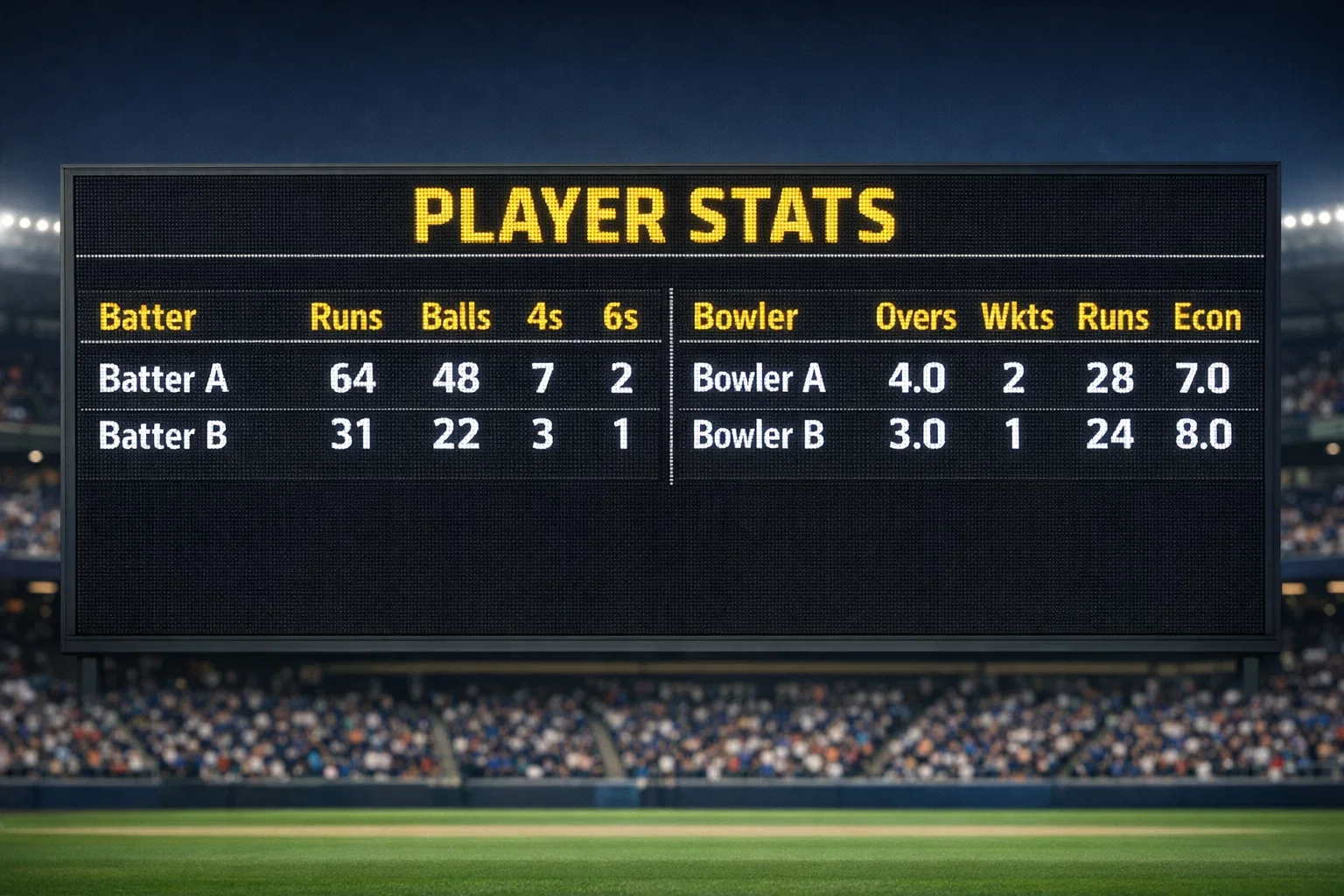
Raw scoring and wicket-taking numbers don't capture everything relevant to form. Secondary indicators often provide earlier or more reliable signals.
How players score matters alongside how much they score. A batsman reaching 40 while struggling against every delivery is in worse form than one reaching 40 while timing the ball beautifully but finding fielders. The latter was unlucky; the former was outperforming their actual ability. Watching how players bat—not just results—reveals form more accurately than scorecards alone.
Bowling form appears in economy rates and control even when wickets don't come. A bowler who beats the bat repeatedly without taking wickets is bowling well despite unflattering figures. One who takes wickets despite loose deliveries is enjoying luck that likely won't persist. Strike rate (balls per wicket) combined with economy rate provides better form indication than either metric alone.
Fielding form affects match outcomes but receives little attention. Players in poor general form often field poorly too—dropped catches, misfields, and sluggish ground work. These fielding lapses don't appear in batting or bowling statistics but indicate general form decline. Conversely, players taking sharp catches and moving energetically in the field are often in good overall touch.
Form Persistence and Regression
Understanding how long form persists—and when it regresses toward baseline—helps predict future performances.
Hot streaks eventually end; cold streaks eventually end. This statistical reality means extreme recent form is unlikely to continue indefinitely. A player averaging 80 over ten innings will likely average lower over the next ten. One averaging 15 will likely average higher. Regression toward the mean is one of the most reliable patterns in sports—betting on its occurrence captures value when markets overweight recent extremes.
Form persistence varies by player experience and career stage. Established veterans have stable baselines—their form fluctuates around a known level. Younger players might be genuinely improving, making recent good performances predictive rather than temporary. Distinguishing improvement from hot streaks requires assessing whether technical or physical development explains recent success.
Injury and fitness affect form persistence differently than pure performance fluctuation. A player returning from injury might perform below baseline while rebuilding match fitness—this isn't random form variation but predictable recovery trajectory. Players carrying minor injuries might show declining form that reflects physical limitation rather than technical struggles.
Format-Specific Form Considerations
Form in one format doesn't necessarily translate to another. A player dominating T20 cricket might struggle in Tests, or vice versa.
Different formats require different skills that fluctuate independently. Test cricket rewards patience, concentration, and defensive technique. T20 cricket rewards aggressive shot-making and boundary hitting. A player whose aggressive form is excellent but whose defensive game is struggling will show good T20 form but poor Test form simultaneously. Assess format-specific form rather than assuming general form applies across formats.
Recent format focus affects current form. Players who've played exclusively T20 cricket for months might need adjustment time returning to longer formats. Those immersed in Test cricket might initially struggle with T20's pace and pressure. When players switch formats after extended periods, expect early performances to lag their true ability as they readjust.
Conditions within formats matter too. A player in excellent form in English conditions might struggle when touring the subcontinent—not due to form decline but due to condition-specific challenges. Separate genuine form changes from condition-related performance variations to avoid misattributing struggles.
Using Form Analysis for Match Betting
Player form analysis improves match betting by identifying when team quality assessments should adjust based on current performance levels.
Aggregate team form from key player assessments. If a team's best three batsmen are all in good form simultaneously, the team is likely to perform above their baseline expectations. If their main bowlers are struggling while opposition batters are peaking, expected match dynamics favor the batting team. Aggregating individual form assessments into team-level adjustments improves match outcome predictions.
Matchup-specific form provides additional precision. A batsman might be in excellent general form but historically struggle against specific bowlers they'll face. A bowler taking wickets regularly might have poor records against the opposition's key batsmen. These matchup overlays refine form-based predictions by identifying where general form might not translate to specific contexts.
Weighting key player form appropriately matters. A team's best player being in excellent form affects predictions more than their fifth-best player being in similar form. Identify which players most influence team outcomes and weight their form assessments accordingly.

Form-Based Player Market Betting
Player markets—top batsman, top bowler, player performance props—are where form analysis provides most direct value.
Top batsman markets reward backing in-form players at value odds. If a batsman is in excellent form but their odds don't fully reflect recent performances, backing them offers value. The challenge is determining when odds already incorporate form information versus when they lag behind recent developments.
Over/under player performance markets let you express form views directly. If you assess a bowler as being in better form than their props line suggests, betting their overs offers value. If a batsman seems overrated based on recent poor form, their unders might be attractive. These markets test your form assessment against bookmaker assessments directly.
Tournament player markets require projecting form across multiple matches. For top scorer in a series or tournament, assess which players are likely to maintain or find form throughout—not just who's currently in form. Players who tend to start tournaments slowly but peak later offer different value than those who start fast but fade.
Building Form Assessment Systems
Systematic approaches to form tracking improve consistency and reveal patterns intuition might miss.
Maintain form ratings for players you regularly bet on. Rate players on a simple scale—below average form, average form, above average form—with notes explaining your rating. Update these ratings after each match they play. Over time, this tracking reveals how your assessments correlate with actual performances and where your form reads are accurate or systematically biased.
Record the evidence supporting form assessments. What specific performances or observations led to your rating? When assessments prove wrong, reviewing your evidence helps identify analytical errors. Were you overweighting single performances? Ignoring context? These insights improve future form assessment.
Compare your form assessments to market movements. When your ratings suggest a player is in better form than markets reflect, note these discrepancies. Track whether your contrarian form views produce value over time. This comparison reveals whether your form analysis actually provides edge or merely reaches similar conclusions to markets through different routes.
